The overall purpose of this digital marketing course was to teach us how businesses promote themselves online and connect with their customers. Throughout the semester I learned new concepts such as search engine optimization, social media marketing, email marketing, and website development. What made this course especially valuable was the mix of learning new concepts and actually getting to put them int practice through our projects. This hands-on experience has helped me apply what I have learned in real-world situations and build skills i can use in the future.
Theoretical Knowledge Gained:
During this course, I was able to gain a strong understanding of how digital marketing works and how businesses can use it to reach their target audience. One of the most important concepts I learned was how consumer behavior influences marketing strategies. We took a deeper look at how people search for information or products online, what affects their decisions, and how businesses can then take that data and adjust their technique to connect with them.
We also were introduced to search engine optimization, where I learned how key words can help websites appear higher on search engines like Google. This really taught me the importance of creating content that is not just interesting but also easy for users to locate.
We also learned about social media marketing and email marketing. I learned how businesses use different platforms such as Facebook, Instagram, and LinkedIn to connect with their target audience and to help them spread the word about their brand. As for email marketing, I learned that companies could send automatic emails right away when a new item comes out or something is low on stock. In our course we used email marketing hands on by creating our own email chain list and then it sends updates when we would make a post.
Overall, these concepts have helped me learn more about all the different areas within digital marketing that work together to create a strong and effective marketing strategy for a business.
Project Summary:
This course has taught me a lot about different marketing strategies by completing and learning from our hands on projects.The main project being creating our own website, from picking out the name to content creation, this project has given me a lot of experience with learning web design. We then picked out two companies to analyze through our eight blog posts.
We also had the chance to create two customer personas for our companies we had choesn. This had really helped me learn about how companies find their target audience by looking at the ages, behaviors, and interests of most their customers. For these customer personas we also had Ai-assist us in certain posts by giving it a specific prompt to generate responses.
Lastly, we went over SEO keyword research, where I learned how a company can help their website be found easier on Google by using the correct wording. We also had an assignment where we had taken both positive and negative Google reviews for both companies and with the help of Ai we analyzed them and found what words were being used the most in the reviews and the least.
Key Skills Acquired:
Before taking this course, I have never created and maintained a website, worked with email automation, or Google Analytics which are all new skills I have acquired from this course.
Website creation was my favorite part, from picking out the website name to learning how to make a post it was all new and exciting to me.
Email automation and Google Analytics were both interesting to me. I really liked learning about all the different types of data you can see on Google Analytics, like how many people have clicked on your website and where they were coming from when they found my website was really neat to learn about.
Ai Tool Utilization Experience:
Many times throughout the semester I had the opportunity to use Ai in my blog posts to help analyze and better my content. On of the main tools used was having Ai create a customer persona and break down the companies Google reviews to find out how the company could improve and what they were already doing good at.
We also used Lenoardo. Ai to generate images of the companies and what a typical day in each business might look like. Creating the images not only saved time but helped me add more visuals and creativity to my blog posts.
Data Analysis Capabilities:
An important part of this course was learning how to analyze your website’s data using Google Analytics (GA4). I first learned how to connect it to a website and then I was able to track total users, sessions visited, and engagements on my website. This helped me to better understand how people are not only finding my website but how much time they interact with it.
I was also able to see what pages or blogs were drawing in more visitors. This metric helped me to know what pages were successful and what pages could use improvement on.
Real Company Analysis Experience:
During this course I was able to analyze two real companies and think about they could improve their digital marketing strategy. The companies that I choose to analyze where Avera Health and Wells Fargo. Using these companies helped me better understand how different industries use digital marketing to connect with their target audiences.
Avera Health Analysis and Proposal
Avera Health is a healthcare organization located in the Eastern part of South Dakota. When taking a deeper look into Avera Health I could see that Avera does a strong job of providing quality health care services and information to their communities. Their website was easy to use and professional, which helps patients easily locate clinic locations, different medical services they provide, and health care resources. In addition to their website, you can find community updates, health tips, and information about their wellness programs on their social media pages.
One improvement Avera could make is improving search engine optimization by creating more posts focusing on the common questions asked by patients and common healthcare concerns. This is one way that could help more people come across Avera’s website when they are searhing up healthcare infformation online.
Wells Fargo Analysis and Proposal
Wells Fargo is a bank that provides online banking tools, making banking more convenient for their customers. Wells Fargo has multiple chains located across the United States as well making them accessible for almost all their customers. Their website and mobile app are easy to use and allow customers to manager their bank accounts, pay bills, deposit checks, and access financial resources quickly.
One area Wells Fargo could continue to improve in is customer engagement on social media. Many people, including the younger audiences, would rather see content that feels more personal and interactive. Some examples could be creating more financial education videos on platforms such as instagram, Tik Tok, and Linkedln to help their customers better understand topics like budgeting, saving money, and how to successully build credit.
Social Media Utilization:
This semester I used Linkedln to share my work and connect with classmates and others. This gave me experience with professional networking and content sharing.
Most of my Linkedln posts where announcements that I have published a new blog post, but it also allowed me to me to connected with my class mates and see their posts. But it also allowed me to connect with other marketing professionals.
Key Achievements:
Linkedln Engagement:
3 Likes
0 comments
0 shares
10 new connections
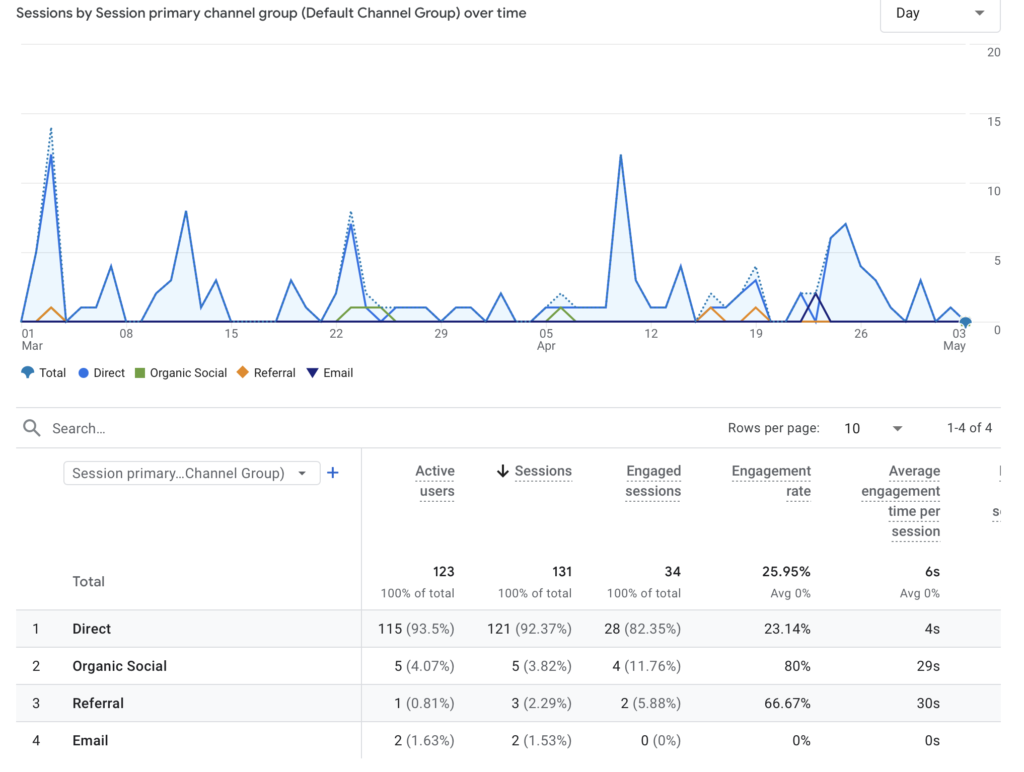
Total traffic in GA4 (March 1 to May 3)
123 active users
131 sessions
34 engaged sessions
Future Application Plans:
In the future I plan to apply these skills that I have learned not only in a professional way but a personal way as well. I hope to continue to grow in learning more about digital marketing by getting even more familiar with website creation and management, social media marketing, and data analytics. These skills will be skills that I will carry with me into future internships and job opportunities as many businesses rely on digital platforms to connect with their customers.
I also plan to apply what I have learned from using Ai to help me improve my website and content creation. This course has given me a great head start for learning about new digital marketing trends and what the future could possibly look like for digital marketing.
Contribution Plans for Target Companies:
The skills I acquired throughout this course will help me to contribute to companies in many ways. I will be able to help improve a company’s social media presence, create content, and analyze website metrics to help the company better connect with their audience.
Personal Growth:
From the beginning of the semester to now I have experienced a huge amount of both personal and professional growth. Before taking this class I have never created or maintained a website and very little digital marketing knowledge. But by completing the hands on projects I feel more confident in my abilities. This course has taught me how to think more creatively, use a varity of different tools, and how to analyze different marketing strategies.
This course has also helped me continue to improve my communication, problem-solving, and computer skills. This course has really shown me how much time and effort goes into bulding a successful online media presence.
I would like to take some time to thank my teacher Sangbong Lee for teaching me these vital skills and for taking the time to always help me and answer any questions I may have had. I would also like to thank the Black Hills State School of Business for uploading our posts to the school’s business page.
In today’s world, understanding how a website performs is important for improving content and reaching the correct audience. This analysis uses Google Analytics 4 (GA4) to take a deeper look at the data, such as page views, engagement, and demographics. These metrics help show how users are finding the website, what content they are most interested in, and where the users are coming from.
User acquisition helps us to identify how new visitors to the page are finding our website and what sources are bringing in the most traffic. Page views help us to understand what pages are being visited more than others, which allows us to know what content is bringing in the most people. Engagement metrics such as engagement times and rates help us measure how the users are interacting with the site and for how long they are staying on the site. Demographic data, such as country and city, helps us see where our users are located and if the website is reaching the correct audience.
Throughout this process, we will also be using ChatGPT to help us analyze the data and explain what each metric means. This will help make it easier to understand the patterns in the users’ behavior and identify ways to improve the website’s performance.
User acquisition- First user source/medium
The first user source/medium is used to show where users are coming from when they first visit the website, helping identify platforms or sources, such as direct traffic, search engines, or referrals, bring in the most users. This is important because it shows which marketing efforts are most effective and where improvements can be made. The metric average engagement time shows how long users stay on the website after arriving from each source, with higher times indicating greater interest in the content. The new users metric helps show how many first-time visitors are coming from each, which is useful for understanding how the website is growing its audience. The engagement rate measures the percentage of users who are actively interacting with the site. Based on the data, direct traffic brings in the highest number of users, while LinkedIn.com and lnkd.in/referral shows varying levels of engagement, which suggests that some channels may attract more interested visitors than others.
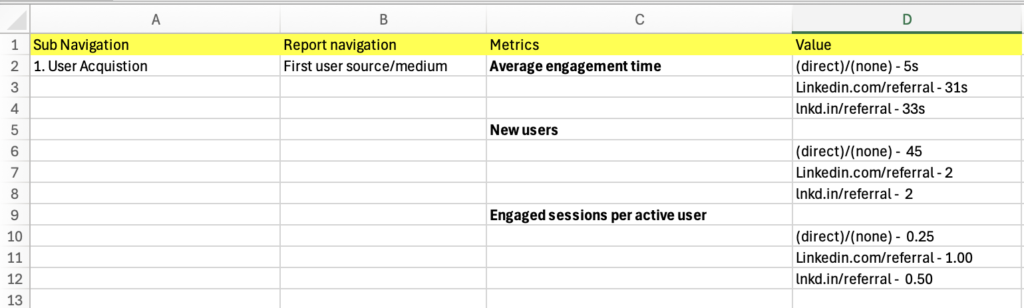
After gathering this information, I entered the relevant information into an Excel sheet to make the information more organized and easier to put into ChatGPT to analyze. Here is the Excel information below.
After I organized the information in Excel, I entered it into ChatGPT in addition to specific prompts to assist in analyzing and understanding what exactly these metrics mean. I copied and pasted the values for the average engagement time, and then I gave ChatGPT a prompt. The prompt I used was: When I sorted the average engagement time in descending order in the First user source/medium classification, the following results came out. Please explain. Here are the results that ChatGPT gave me
Here’s how to interpret those results in a simple way:
1. direct / (none) – 5 seconds
This means people came directly to your website (no referral source tracked).
Examples:
Typed your URL into the browser
Used a bookmark
Clicked an untracked link (like from texts or some apps)
👉 Why engagement is low (5s): These users are leaving almost immediately, which usually means:
They didn’t find what they expected
The page didn’t load well or wasn’t engaging
It could even include accidental clicks
📌 Takeaway: This traffic is low quality or mismatched—you may want to improve your landing page or check where these users are coming from.
2. linkedin.com / referral – 31 seconds
These users clicked a link from LinkedIn directly (full URL shown).
👉 Why engagement is higher:
They likely saw a post, profile, or company page
They had some interest before clicking
📌 Takeaway: LinkedIn is bringing more engaged users than direct traffic.
3. lnkd.in / referral – 33 seconds
This is also LinkedIn traffic, but through shortened links (LinkedIn uses lnkd.in for shared links).
👉 Why it’s slightly higher (33s):
These are often links shared in:
Posts
Messages
Comments
People clicking these are usually more intentional
📌 Takeaway: This is actually your most engaged traffic source of the three.
Overall Insight (what this tells you)
Best traffic: LinkedIn (especially shortened links) → people stay longer
Worst traffic: Direct → people leave almost instantly
LinkedIn referrals generate higher engagement because users arrive with prior interest, while direct traffic shows very low engagement, suggesting weaker intent or poor landing page effectiveness.
After this, I went on to the next section, where I used ChatGPT to analyze the data I collected from new users to the website. I copied and pasted the next three cells under the values heading that corresponded to new users. I then gave ChatGPT this prompt: When I sorted the new users in descending order in the First user source/ medium classification, the following result came out. Please explain. Below was what ChatGPT responded with.
Here’s what your results mean in a simple, clear way:
📊 Your Data
(direct) / (none) — 45 new users
linkedin.com / referral — 2 new users
lnkd.in / referral — 2 new users
🧠 What “new users” means
“New users” = people visiting your website for the very first time
So you’re basically seeing where your first-time visitors are coming from
🔍 Explanation of each source
1. (direct) / (none) — 45 (MOST of your traffic)
This means people came to your site without a tracked source
This usually happens when they:
Typed your website URL directly
Clicked a bookmark
Clicked a link in a text message or DM
Clicked from apps that don’t pass tracking data (like some emails or social apps)
👉 Why it’s so high: Most of your new users didn’t come from trackable marketing links—they found your site more “privately” or directly.
2. linkedin.com / referral — 2
These users:
Clicked a link to your site from LinkedIn
Came from the actual LinkedIn website
👉 This shows:
You do have some traffic coming from LinkedIn posts or profiles
But it’s very small compared to direct traffic
3. lnkd.in / referral — 2
This is also from LinkedIn, but slightly different:
lnkd.in is LinkedIn’s shortened link
Happens when someone shares a shortened LinkedIn link (common in posts/messages)
👉 So these 2 users also came from LinkedIn—just via a shortened link
📌 Big Picture Insight
Your site is getting most new users from “direct” traffic (45 vs 4 from LinkedIn)
LinkedIn is contributing very little traffic overall
As for the last section, I used ChatGPT to analyze the data I collected on the engaged users per activate session. I gave ChatGPT another prompt followed by the last three cells under the value heading that are related to engaged users per active session. Here is the prompt I used: When I sorted the engaged sessions per active user in descending order in the First user source/medium classification, the following results came out. Please explain. Here are the results ChatGPT gave me.
Here’s how to understand this metric and your results:
🧠 What “Engaged sessions per active user” means
This measures how engaged each user is on average
👉 Formula (conceptually): Engaged sessions ÷ Active users
An engaged session = a visit where the user actually interacts (stays longer, clicks, views multiple pages, etc.)
An active user = a person who visited your site
👉 So:
Higher number = more engagement per person
Lower number = less interaction per person
📊 Your Results Explained
1. linkedin.com / referral — 1.00 (HIGHEST)
Each user from LinkedIn had about 1 engaged session per user
This means:
Almost every LinkedIn visitor actively interacted with your site
👉 💡 Insight: LinkedIn users are high-quality traffic — fewer people, but more engaged
2. lnkd.in / referral — 0.50
Each user had about 0.5 engaged sessions
This means:
Some users engaged, some didn’t
👉 💡 Insight: Still decent engagement, but not as strong as direct LinkedIn traffic
3. (direct) / (none) — 0.25 (LOWEST)
Only 0.25 engaged sessions per user
This means:
Most users coming directly are not interacting much
👉 💡 Insight: You have a lot of direct traffic, but it’s low quality / low engagement
📌 Big Picture Takeaway
Direct traffic = high volume, low engagement
LinkedIn traffic = low volume, high engagement
Engagement- Page title and screens
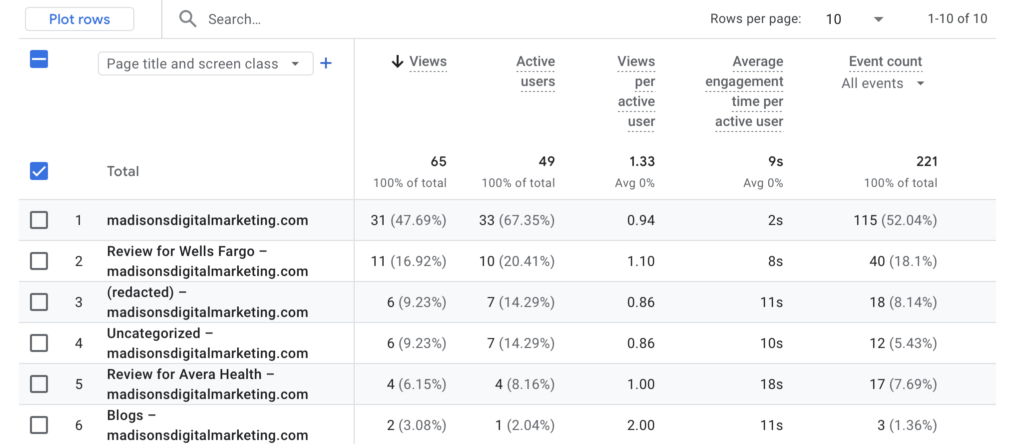
We can use the page titles and screens to determine which pages, or in our case, blog posts, are seeing the most engagement. The metrics analyzed in this section include average engagement time, views, and new users. Average engagement time measures how long users spend interacting with the page content; higher times indicate there is great interest and engagement. Views represent how often the content is seen; this helps show how effectively it is being discovered through promotional efforts. Lastly, new users indicate the number of first-time visitors to the site, which helps measure audience growth. The image below displays GA4 analytics data highlighting these three metrics for the blog website currently being viewed.
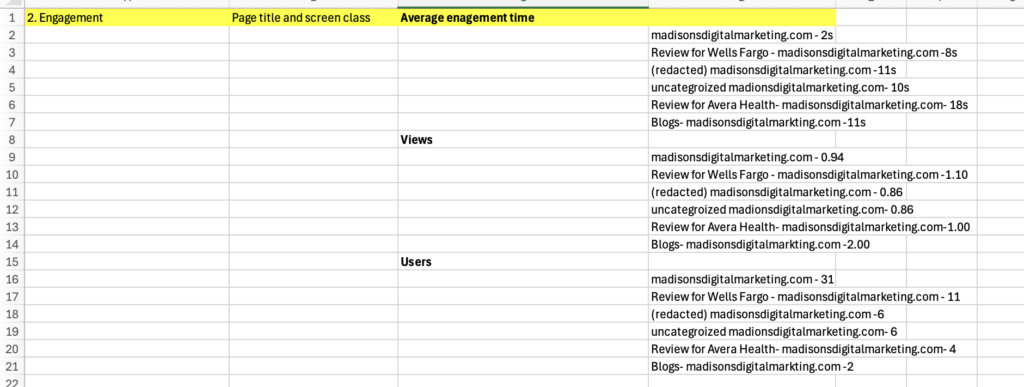
After collecting this information, I then entered in the relevant information into an Excel spreadsheet to help make it easier for ChatGPT to analyze and transfer it over to ChatGPT. Below is the spreadsheet information.
Now that I have fully organized the information in the Excel spreadsheet, I entered this information along with new specific prompts into ChatGPT to help further analyze and understand these metrics. I entered in a prompt to ChatGPT followed by copying and pasting the first six cells of information on the right side related to average engagement time. The prompt I used was: When I sorted the average engagement time in descending order in the page title and screen class classification, the following results came out. Please explain. Below are the results from ChatGPT.
When you sort average engagement time (descending) by Page title and screen class, you’re basically seeing which pages keep users’ attention the longest → shortest. Here’s what your results are telling you:
🔝 Highest Engagement
Review for Avera Health – 18s This page has the highest engagement time, meaning visitors are spending the most time here. 👉 Likely reasons:
The content is interesting or detailed
Users are actually reading the full review
Could be more relevant to your audience
📊 Mid-Level Engagement
(redacted) – 11s
Blogs – 11s
Uncategorized – 10s
Review for Wells Fargo – 8s
These pages have moderate engagement, meaning:
People are spending some time, but not a lot
They might be skimming instead of fully reading
Content may not be as engaging or clear
👉 Example:
Your Blogs page (11s) might not be pulling people in enough to stay longer
The Wells Fargo review (8s) could be less interesting or shorter than Avera
⚠️ Lowest Engagement
madisonsdigitalmarketing.com (homepage) – 2s
This is a big insight. 👉 A 2-second engagement time usually means:
Users are leaving almost immediately
They might not find what they expected
The homepage may not be visually engaging or clear
🧠 Overall Explanation (what this means)
Pages with higher engagement time = more interesting or useful content
Pages with lower engagement time = users are leaving quickly or not interacting
For the next section, I used ChatGPT to analyze data regarding views on the site. I entered a prompt, followed by copying and pasting the next six rows on the far right side related to views. This was the prompt I used: When I sorted the views in descending order in the page title and screen class classification, the following results came out. Please explain. Here was ChatGPT’s response.
When you sort views (descending) by Page title and screen class, you’re looking at which pages are being seen the most → least. Here’s what your results mean:
🔝 Most Viewed Page
Blogs – 2.00
This page has the highest number of views, meaning: 👉 It is the most visited page on your site 👉 Your blog content is what people are finding the most 👉 This could be from sharing links, SEO, or internal navigation
📊 Moderate Views
Review for Wells Fargo – 1.10
Review for Avera Health – 1.00
These pages are getting some traffic, but not as much as the blog: 👉 People are finding these reviews, but they’re not as popular 👉 Could mean less promotion or less interest compared to blogs
⚖️ Lower Views
madisonsdigitalmarketing.com (homepage) – 0.94
(redacted) – 0.86
Uncategorized – 0.86
These pages have the lowest views, meaning: 👉 Fewer users are visiting them 👉 They may not be easily accessible or well-promoted 👉 Could also mean users are not navigating to these pages from your homepage
🧠 Overall Explanation (what this shows)
Pages with higher views = more visibility and traffic
Pages with lower views = less discovery or weaker promotion
Your results show that: 👉 The Blogs page is performing the best in terms of traffic 👉 Review pages are doing okay but could improve 👉 Other pages (like homepage or uncategorized) are not getting much attention
For the last section, I used ChatGPT to analyze the new users who had visited the website. I entered the new prompt followed by the last six cells that correspond to new users. Here is the prompt I gave ChatGPT: When I sorted the users in descending order in the page and title screen class classification, the following results came out. Please explain. This was ChatGPT’s response.
When you sort users (descending) by Page title and screen class, you’re seeing which pages are attracting the most individual visitors → least. Here’s what your results show:
🔝 Most Users
madisonsdigitalmarketing.com (homepage) – 31
This page has the highest number of users, meaning: 👉 Most people are landing on your homepage first 👉 It acts as the main entry point to your website 👉 This is normal for most websites
📊 Moderate Users
Review for Wells Fargo – 11
👉 This page is getting a decent number of visitors 👉 Some users are navigating from the homepage to this review 👉 It shows moderate interest in this topic
⚖️ Lower Users
(redacted) – 6
Uncategorized – 6
👉 These pages are getting fewer visitors 👉 They may not be easy to find or not strongly promoted 👉 Users may not be clicking into these pages as often
⬇️ Lowest Users
Review for Avera Health – 4
Blogs – 2
👉 These pages have the fewest users, meaning:
Very few people are reaching them
They may need better visibility (links, SEO, or promotion)
Even though blogs had high views earlier, fewer unique users may mean:
The same users are viewing it multiple times, or
It’s not reaching new visitors
🧠 Overall Explanation
Users = number of individual visitors
Higher users = more people visiting that page
Lower users = fewer people discovering or clicking into it
Your data shows: 👉 The homepage brings in most users 👉 Some users explore review pages 👉 Other pages (especially blogs) are not attracting many unique visitors
User attributes – Demographic details
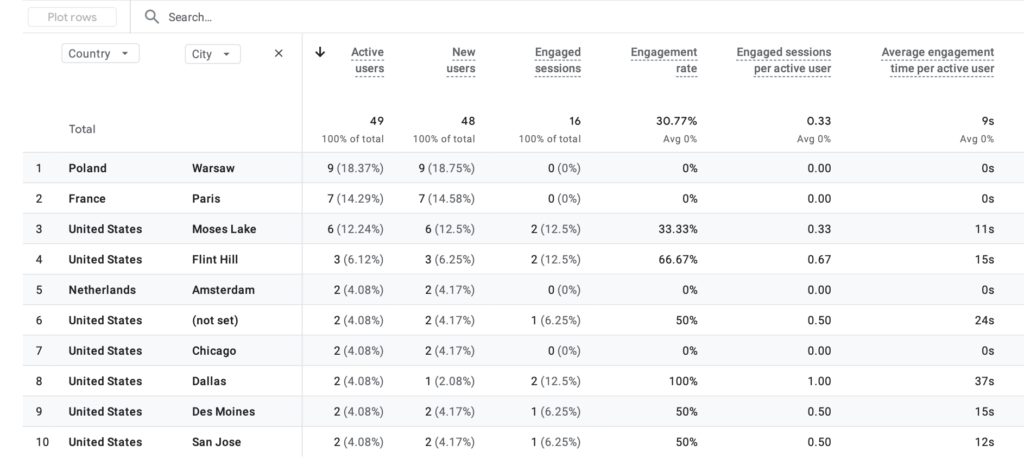
For the demographic analysis, the focus is on users’ country and city to determine whether the website is reaching its intended target audience. The key metrics used in this section include active users, engagement rate, average engagement time per active user, and engaged sessions per active user. Active users indicate how many visitors are coming from each location, while engagement rate shows the percentage of users who are interacting with the content. Average engagement time per active user measures how deeply users from each location engage with the website. Engaged sessions per active user reflect how frequently users from each location return and interact with the site.
The image below displays the GA4 analytics for these demographic metrics on the blog website.
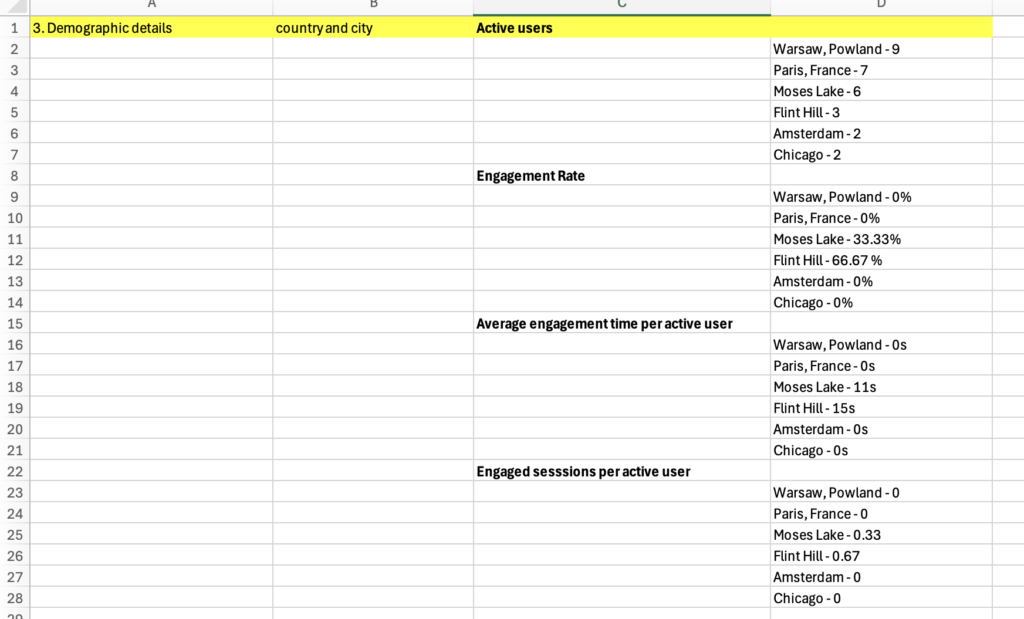
Now that I have located the information, I entered a few locations and their information into an Excel sheet so it will be easier to identify and use this information to be further analyzed with the help of ChatGPT. Below is the Excel sheet.
Now that we have organized the information, I will use ChatGPT to take a deeper look into the information. For this portion, we group all four metrics into one prompt and had ChatGPT only give us one response instead of multiple responses. The prompt I used was: Let’s begin the analysis assuming my cities of interest are Warsaw, Paris, Moses Lake, Flint Hill, Amsterdam, and Chicago. When I sorted Active users in descending order in the Country and city classification, the following result came out. Please explain <add data on Active users here>. When I sorted the engagement rate in descending order in the Country and city classification, the following result came out. Please explain <add data on Engagement rate here>. When I sorted Average engagement time per active user in descending order in the Country and city classification, the following result came out. Please explain <add data on Average engagement time per active user here>. When I sorted Engaged sessions per active user in descending order in the Country and city classification, the following result came out. Please explain <add data on Engaged sessions per active user here>. Finally, please provide a conclusion based on the answers to these four questions. I would then follow the prompt by copying and pasting the corresponding Excel sheet information into each of the areas that said to add data here to get the completed prompt. This was the result from ChatGPT.
1. Active Users (Descending Order):
Warsaw, Poland (9 users): Highest number of active users, meaning this location drives the most traffic to the website.
Paris, France (7 users): Second highest traffic, showing strong visibility in this location.
Moses Lake (6 users): Moderate number of users visiting the site.
Flint Hill (3 users): Lower traffic compared to the top cities.
Amsterdam (2 users): Minimal traffic.
Chicago (2 users): Also minimal traffic.
2. Engagement Rate (Descending Order):
Flint Hill (66.67%): Highest engagement rate, meaning users here interact the most with the content.
Moses Lake (33.33%): Moderate engagement, showing some user interaction.
Warsaw, Poland (0%): No engagement despite high traffic.
Paris, France (0%): Users are visiting but not interacting.
Amsterdam (0%): No engagement.
Chicago (0%): No engagement.
3. Average Engagement Time per Active User (Descending Order):
Flint Hill (15s): Highest time spent, indicating strong interest in the content.
Moses Lake (11s): Moderate engagement time.
Warsaw, Poland (0s): No time spent engaging with content.
Paris, France (0s): Users leave quickly.
Amsterdam (0s): No engagement time.
Chicago (0s): No engagement time.
4. Engaged Sessions per Active User (Descending Order):
Flint Hill (0.67): Highest return and interaction rate.
Moses Lake (0.33): Some repeat engagement.
Warsaw, Poland (0): No engaged sessions.
Paris, France (0): No engaged sessions.
Amsterdam (0): No engaged sessions.
Chicago (0): No engaged sessions.
Conclusion:
Cities like Warsaw and Paris bring in the most users, but those users are not engaging with the content.
Flint Hill and Moses Lake have fewer users but much higher engagement, meaning the content is more relevant to those audiences.
This suggests the website is reaching a broad audience but only strongly connecting with certain locations. Improving content or targeting for high-traffic cities could help increase overall engagement.
Conclusion
This process demonstrates how Google Analytics (GA4) can be used to evaluate website performance and identify the audience it is reaching. It helps highlight areas where the website is performing well and areas where the website may need improvement. By using AI tools like ChatGPT, the data collected from Google Analytics can be further analyzed by inputting it along with certain prompts, allowing us to gain a deeper understanding of what the metrics mean and how they are impacting the overall performance of the website
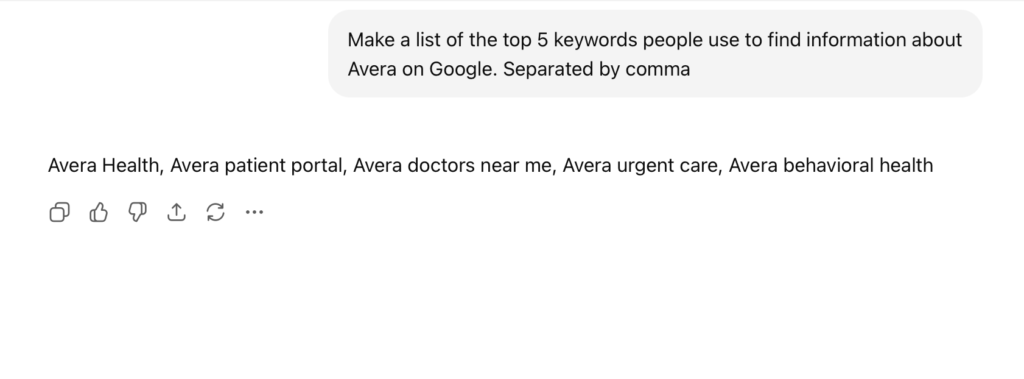
Building on the previous blog post, where we discussed the use of AI in digital marketing, this analysis will focus on using AI to evaluate customer reviews for Avera Health. We will be using ChatGPT to analyze selected Google Maps customer reviews by entering specific prompts and examining the feedback, starting with positive reviews.
Analyzing positive reviews
First analysis
To start the first analysis, I began by going to Google Maps and searching for Avera Health, located in Sioux Falls, SD. I then found the review section, and I set the sort filter to the highest ratings. I then copied and pasted A portion of the highest reviews for ChatGPT. Next, I inserted the following specific prompt into ChatGPT, followed by the positive Google Map reviews. The prompt I inserted was: What are the customers most satisfied with based on the reviews? This is the result ChatGPT found using the information.
Based on these reviews, customers seem most satisfied with the staff and quality of care.
The biggest satisfaction themes are:
1. Caring, compassionate nurses and doctors This is the strongest pattern by far. Reviewers repeatedly mention that nurses, doctors, and care teams were:
caring
compassionate
kind
friendly
attentive
respectful
genuine
Examples include comments like “they actually care,” “amazing nurses and doctors,” “angels for sure,” and “best care.”
2. High-quality medical care and expertise Many reviews praise the hospital for:
saving lives
excellent ICU and ER care
strong surgical care
knowledgeable providers
well-trained staff
effective treatment during critical situations
People especially appreciated feeling they were “in good hands” during serious or emergency situations.
3. Communication and support Customers were also very happy with staff who:
explained things clearly
answered questions
helped families understand what was happening
took time with patients
made people feel supported during stressful moments
This comes up in reviews about ICU, pregnancy care, emergency care, and specialty treatment.
4. Friendliness and professionalism Many reviewers mention that employees were:
polite
professional
helpful
welcoming
easy to work with
This includes not only doctors and nurses, but also reception, security, records staff, and other support staff.
5. Specialized and critical care areas Several departments get specific praise, especially:
ICU
ER
maternity/pregnancy care
surgery/surgical center
cancer care
mental/behavioral health
NICU
This suggests customers are especially satisfied when Avera handles serious or complex cases.
6. Cleanliness and comfort A smaller but still noticeable theme is satisfaction with:
a clean hospital
a welcoming environment
good food
quick valet/helpful navigation
Overall conclusion
Customers are most satisfied with the compassionate staff, especially nurses and doctors, along with the hospital’s strong quality of care during serious medical situations.
Avera Health impresses its patients with their “caring staff”, high-quality medical care, and their “support and communication”.
Second Analysis
This second analysis involves looking at the best reviews and examining the words associated with these reviews. To do this, I entered another specific prompt into ChatGPT. The prompt was: Extract positive keywords from those reviews, and analyze the frequency and associations of these keywords. This was ChatGPT’s response:
Here’s a review-based positive keyword extraction and association analysis from the reviews you pasted.
Because the reviews are informal and some repeat, these are approximate frequency counts based on the visible text.
Most common positive keywords
Positive keyword/theme
Approx. frequency
What it suggests
care / caring
20+
Patients most value feeling cared for emotionally and physically
nurses / nursing staff
18+
Nurses are the most frequently praised group
doctors
12+
Doctors are strongly associated with trust and expertise
staff
12+
Overall hospital team leaves a positive impression
amazing
10+
Strong emotional praise for the experience
friendly
8+
Patients appreciate warmth and approachability
helpful
8+
Staff are seen as useful, responsive, and supportive
professional
6+
Reviews reflect confidence in staff competence
kind / kindness
6+
Emotional sensitivity matters a lot to patients
compassionate / compassion
6+
Patients connect quality care with empathy
attentive
5+
Responsiveness is important to satisfaction
knowledgeable / informative / well trained
5+
Expertise and communication drive trust
respectful
4+
Patients value being treated with dignity
excellent / outstanding / top notch / phenomenal / superb
10+
Reviews use strong performance words repeatedly
clean
3+
Cleanliness supports the positive hospital image
quick / timely / seen quickly
4+
Speed and efficiency add to satisfaction
comfortable / at home / good hands
5+
Emotional safety is a key theme
Strongest positive themes
1. Compassionate care
The most dominant language centers on:
care
caring
compassion
kind
genuine
sweet
polite
This suggests customers are especially satisfied with the hospital’s human side of care, not just clinical outcomes.
2. Nursing excellence
“Nurses” appears more often than any other staff role. Common words associated with nurses include:
amazing
caring
friendly
attentive
top notch
angels
best
This shows that nursing staff are the main driver of positive patient satisfaction.
3. Trust in medical expertise
Doctors and medical teams are often described as:
knowledgeable
informative
competent
well trained
professional
excellent
This means patients associate Avera with strong clinical ability, especially in serious cases like ICU, surgery, pregnancy complications, cancer, and emergency care.
4. Emotional reassurance during stressful situations
A lot of reviews involve high-stress experiences, and positive keywords cluster around reassurance:
good hands
comfortable
helped us understand
answered questions
actually care
saved my life
This suggests satisfaction is strongly tied to the hospital’s ability to make patients and families feel safe, informed, and supported.
Keyword associations
Here are the main positive keyword pairings that show up together:
When people mention “staff” broadly, they usually mean the hospital creates a consistently positive service environment.
Care → compassionate, quality, excellent, life-saving
The word “care” is associated with both clinical quality and emotional warmth.
ICU / ER / surgery / NICU / maternity → excellent, phenomenal, superb, saved life
Specialized departments are linked with some of the strongest praise words, suggesting high satisfaction in critical-care settings.
Communication → informative, answered questions, helped understand
Positive experiences are often tied to clear explanations and responsiveness, especially for families.
Environment → clean, welcoming, comfortable, food
A smaller but still positive cluster points to satisfaction with the facility experience, not just treatment.
What customers seem most satisfied with overall
From the keyword patterns, customers are most satisfied with:
1. Compassionate nurses and staff 2. Knowledgeable doctors and strong medical expertise 3. Clear communication and emotional support 4. Excellent care in critical or specialized situations 5. A professional, friendly, and reassuring environment
Summary of Findings
The keywords that were most frequently used in the reviews were “care”, “caring”, “nurses”, “doctors”, “amazing”, “friendly”, “helpful”, and “professional”. They are strongly associated with compassionate nurses and very educated doctors, quality treatment, and supportive communication. Overall, the reviews suggest that Avera’s patients are most satisfied with Avera’s compassionate staff and high quality care during both routine and critical medical situations.
Recommendation
Now that we have found some positive reviews and keywords that go with those reviews, we will look at some recommendations for Avera to keep up the positive reviews. To get these recommendations, we will enter another specific prompt into ChatGPT. The prompt I used was: What would be the suggestions from the findings? Here are the suggestions that ChatGPT found to keep these positive reviews.
Based on the positive keyword findings and themes from the reviews, the hospital can focus on strategies that maintain and strengthen the factors customers already value most.
1. Continue investing in compassionate patient care
Since the most common keywords relate to caring, compassion, kindness, and empathy, the hospital should continue emphasizing patient-centered care. Ongoing training programs for nurses, doctors, and staff that reinforce empathy, active listening, and respectful communication can help maintain this strength.
2. Highlight nursing excellence
Nurses were mentioned more frequently than any other staff group and were strongly associated with positive words such as amazing, attentive, friendly, and supportive. The hospital could continue supporting nursing staff through recognition programs, professional development opportunities, and adequate staffing levels to ensure high-quality patient interactions.
3. Maintain strong communication with patients and families
Many reviews praised staff for explaining procedures, answering questions, and helping families understand medical situations. The hospital could continue to encourage clear communication by providing staff training on patient education and ensuring that patients and families feel informed throughout their care experience.
4. Promote expertise and quality of care in marketing efforts
Customers frequently mentioned knowledgeable doctors, well-trained staff, and life-saving care, especially in departments such as the ICU, ER, maternity, and surgery. These strengths could be highlighted in marketing materials, social media, and patient testimonials to strengthen the hospital’s reputation for high-quality medical care.
5. Maintain a welcoming and comfortable hospital environment
Some reviews mentioned clean facilities, friendly reception staff, and overall comfort. Continuing to maintain a clean, organized, and welcoming environment can help reinforce positive patient experiences.
Negative review analysis
Review collection
We will now repeat the same process of entering specific prompts to ChatGPT in addition to copying and pasting all of Avera Health’s one and two-star negative reviews.
Analyzing negative reviews
First Analysis
To start the negative review analysis for Avera, I started by going to Google Maps and searching for Avera Health, located in Sioux Falls, SD. I then selected the reviews tab and clicked the sort tab, then I filtered the reviews to show the lowest ratings. I then copied all the one and two-star reviews. Next, I went into the chat box of ChatGPT, and I typed in a specific prompt and pasted the reviews following the prompt. Here is the prompt I used: What are the customers least satisfied with based on the reviews? Here is the response.
Based on these reviews, customers are least satisfied with a few clear recurring problem areas. Here’s a structured breakdown of the main complaints:
1. Billing & Financial Issues (MOST common complaint)
Confusing or incorrect bills
Being charged without notice
Difficulty fixing billing errors
Aggressive collections / debt collectors
Overpriced services
Examples:
“Never received any correspondence regarding a balance”
“Made 20+ calls over 6 months”
“Paid bill already but still got called”
“Thousands of dollars for 4 hours”
👉 Key takeaway: Customers feel the billing system is unorganized, unfair, and stressful
2. Poor Staff Attitude & Lack of Compassion
Rude, disrespectful, or dismissive staff
Patients feeling judged, ignored, or talked down to
Lack of empathy in serious situations
Examples:
“Unprofessional, uncaring, rude staff”
“Talked to me like I was stupid”
“Made me feel completely stupid”
“Very cold and uncaring”
👉 Key takeaway: Patients feel emotionally unsupported and disrespected
3. Long Wait Times & Slow Service
Long ER wait times even in urgent situations
Delays in care and treatment
Examples:
“Waiting over 40 minutes with serious injuries”
“Made him wait with heart issues”
👉 Key takeaway: Customers feel care is too slow, even for emergencies
4. Poor Communication & Coordination
Staff giving conflicting information
Lack of updates to patients/families
Not returning calls or following up
Examples:
“Told different things by different staff”
“Never contacted me with updates”
“They won’t call you back”
👉 Key takeaway: Patients feel confused and left in the dark
5. Quality of Care & Safety Concerns
Misdiagnosis or dismissed symptoms
Concerns about infection control
Feeling unsafe or poorly treated
Examples:
“Doctors dismissed stroke symptoms”
“Ignored infection protocols”
“Very dangerous / sketchy”
👉 Key takeaway: Customers question competence and safety of care
6. Insurance & Financial Bias
Perception that care depends on insurance status
Feeling treated differently based on ability to pay
Example:
“Good care only if you have insurance”
👉 Key takeaway: Customers feel the system is unfair and profit-driven
7. Administrative & Process Issues
Appointment scheduling problems
Poor follow-through
Missing paperwork or prescriptions
👉 Key takeaway: Internal processes feel disorganized and unreliable
8. Facility Policies & Environment Complaints
Security checkpoints slowing care
Dogs in facility (allergy issue)
Lack of accommodations for families
📊 Overall Conclusion (Short Summary)
Customers are least satisfied with billing practices, staff attitude, and communication, followed by wait times and quality of care concerns.
👉 The biggest pattern: Patients feel the hospital is disorganized, profit-focused, and lacking compassion.
Second Analysis
For the second analysis, we will look closely at each negative review and the most commonly used words in the reviews. In order to find these specific words, I gave ChatGPT a specific prompt. This was the prompt I used: Extract negative keywords from those reviews, and analyze the frequency and associations of these keywords. Here was the response ChatGPT gave us.
Here’s a negative keyword extraction and simple frequency/association analysis based on the reviews you shared
no paperwork, scheduling issues, follow-up problems
6
🔗 Keyword Association
Main Keyword
Commonly Appears With
Insight
Billing
insurance, collections, cost, paid
Financial frustration is widespread and connected to insurance issues
Rude / Uncaring
staff, ER, nurses, doctors
Negative experiences are tied to frontline staff
Ignored
serious symptoms (stroke, heart issues)
Patients feel unsafe when concerns aren’t taken seriously
Wait
ER, pharmacy, appointments
Delays occur across multiple departments
Communication
family, updates, conflicting info
Lack of clarity increases frustration
Insurance
care quality, access
Perception that care depends on ability to pay
📌 Top 5 Most Frequent Negative Keywords
Billing / Financial (18)
Rude / Uncaring (16)
Poor Care / Ignored (12)
Severe Negative Words (11)
Communication Issues (10)
🧠 Simple Summary
The most frequent negative keywords relate to billing issues, rude staff, and poor quality of care. These keywords often appear together, showing that customers feel both financially frustrated and emotionally unsupported, especially when dealing with serious medical concerns.
Summary of Findings
The main negative keywords are “billing issues”, “rude staff”, and “poor quality of care”. This shows where areas of improvement can be made, such as being more caring to patients, working more with patients on a payment plan, or ways to help them through their financial struggles, and giving better care to their patients. By focusing on improving each of these categories, this could help lower the pain points for Avera patients.
Recommendation
After finding the negative reviews for Avera and the keywords that go along with these reviews, we will now look into some recommendations to help Avera avoid gaining any more negative reviews. To get these recommendations, I gave ChatGPT another specific prompt. The prompt I used was: What would be suggestions from the findings? Here are the results from ChatGPT.
Here are clear, actionable suggestions based directly on the patterns in your findings:
Problem: Most complaints are about billing confusion, errors, and collections.
Suggestions:
Provide clear, upfront cost estimates before treatment when possible
Send timely and accurate billing statements (no missing notices)
Create a dedicated billing support team with faster response times
Simplify bills (plain language, breakdown of charges)
Offer flexible payment plans before sending accounts to collections
👉 Goal: Reduce financial stress and confusion for patients
2. Improve Staff Training on Empathy & Communication
Problem: Many reviews mention rude, uncaring, or dismissive staff.
Suggestions:
Implement mandatory customer service & empathy training
Train staff to actively listen and validate patient concerns
Use patient-centered communication scripts in high-stress areas (like ER)
Monitor staff performance through patient feedback surveys
👉 Goal: Make patients feel respected, heard, and cared for
3. Reduce ER Wait Times & Improve Triage Communication
Problem: Long waits, even in urgent situations, frustrate patients.
Suggestions:
Improve triage prioritization systems for serious conditions
Provide real-time wait time updates to patients
Have staff regularly check in with waiting patients
Increase staffing during peak hours if possible
👉 Goal: Improve patient confidence and reduce anxiety during emergencies
4. Strengthen Communication & Follow-Up Systems
Problem: Patients report no updates, conflicting information, and no callbacks.
Suggestions:
Assign a primary point of contact for each patient
Ensure consistent information across doctors, nurses, and staff
Implement automated follow-up calls/texts for appointments and updates
Require timely communication with patient families in serious cases
👉 Goal: Eliminate confusion and build trust
5. Improve Perceived Quality of Care & Safety
Problem: Patients feel ignored or unsafe, especially with serious symptoms.
Suggestions:
Reinforce clinical protocols for high-risk symptoms (stroke, heart issues)
Encourage staff to take all concerns seriously
Conduct regular quality assurance reviews of patient cases
Improve infection control communication and visibility
👉 Goal: Increase trust in medical competence and safety
6. Address Insurance & Fairness Concerns
Problem: Patients feel care depends on insurance status.
Suggestions:
Clearly communicate that care quality is equal regardless of insurance
Provide financial counseling for uninsured patients
Expand awareness of assistance programs and clinics
👉 Goal: Reduce perception of unfair or profit-driven care
7. Improve Administrative Efficiency
Problem: Issues with scheduling, paperwork, and follow-through.
Suggestions:
Digitize and streamline paperwork and records systems
Improve appointment scheduling reliability
Ensure prescriptions and instructions are properly communicated before discharge
👉 Goal: Create a smoother, more reliable patient experience
📊 Overall Strategic Recommendation
The hospital should focus on three key areas:
Financial transparency (billing)
Human experience (staff attitude)
Communication consistency
🧠 Short Conclusion
To improve patient satisfaction, the organization should prioritize billing transparency, staff empathy training, and better communication systems. Addressing these key issues would significantly reduce negative experiences and rebuild patient trust.
By considering these recommendations and implementing them, this could help enhance patient satisfaction by directly addressing the common frustrations related to billing, hospitality, and quality of care.
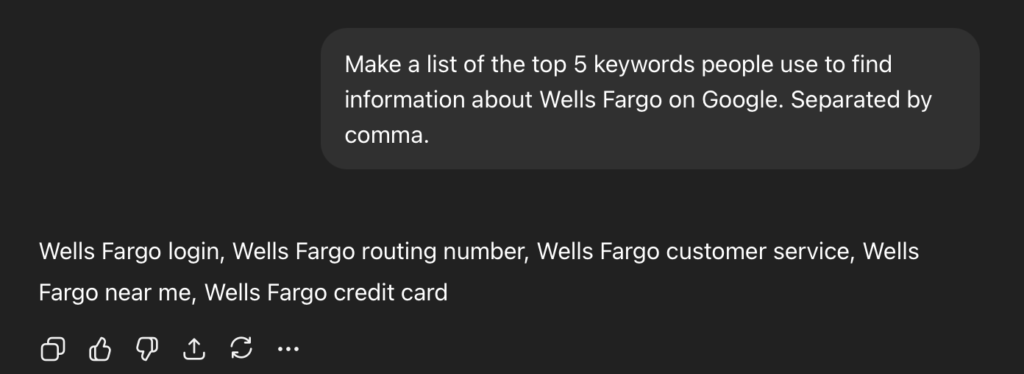
Building on the previous blog post discussing the use of AI in digital marketing, this analysis will focus on using AI to evaluate customer reviews for Wells Fargo. We will be using ChatGPT to analyze selected Google Maps customer reviews by entering specific prompts and examining the feedback, starting with positive reviews.
Analyzing positive reviews
First analysis
To start the process, I went into Google Maps and searched for Wells Fargo, located in Rapid City, SD. I then located the reviews tab and set the sort filter to the highest ratings. To make it easy for AI to review this information, I selected a portion of the highest positive review, as AI could not analyze all the reviews. For the first analysis of Wells Fargo customer reviews, I inserted the following prompt into the chat text box, followed by pasting in the copied Google Maps reviews. Here is the exact prompt I inserted: What are the customers most satisfied with based on the reviews? This was the results that ChatGPT returned using the given Information.
Based on the reviews you shared, customers are most satisfied with the customer service and staff friendliness at the bank.
Main things customers liked
1. Friendly staff
Many reviews mention employees being kind, friendly, and having great attitudes.
Examples:
“Hands down some of the friendliest people!”
“Very friendly customer service.”
“Great people working there.”
2. Helpful employees
Customers appreciated staff who went above and beyond to help with banking issues.
Example:
One review specifically praised Yolanda for being helpful, quick, and going above expectations.
3. Fast / efficient service
Some reviews mention quick service and getting help efficiently.
Examples:
“Fast.”
“Quick and friendly service.”
4. Positive overall banking experience
Customers say the bank makes banking easy and answers questions.
Examples:
“They help me with all my questions and concerns.”
“Couldn’t be a nicer group of people to work with.”
✅ Overall summary: Customers are most satisfied with friendly staff, helpful service, and quick assistance when they visit the bank.
We can see from this first anaylisis that Wells Fargo that impresses their customers with their great customer service, efficient service, and positive banking experiences.
Second Analysis
For the second analysis we will take the best reviews and break them down and examine the words associated with these reviews. To complete this analysis I used another specified prompt into ChatGPT. The prompt I used was: Extract positive keywords from those reviews, and analyze the frequency and associations of these keywords. These were the results that ChatGPT provided.
From the reviews you provided, I extracted the main positive keywords and then analyzed how often they appear and how they are associated with each other.
1. Positive Keywords Extracted
The most common positive words or phrases mentioned in the reviews include:
Most frequent positive keywords: ➡️ Friendly, Helpful, Great, Quick/Fast
3. Keyword Associations (Words That Appear Together)
Certain keywords commonly appear together in the reviews:
Keyword Pair
Meaning
Friendly + Helpful
Staff are approachable and willing to assist
Quick + Friendly
Service is efficient but still personable
Helpful + Kind
Employees go beyond basic service
Great + People/Staff
Positive experience because of employees
4. Overall Insight
The review analysis shows that customers value the human interaction at the bank the most. The most frequent words (friendly, helpful, quick) indicate that staff behavior and service efficiency are the main drivers of customer satisfaction.
Summary of Findings
We can see that from the results provided by ChatGPT the most used key word was “Friendly” then “Helpful” and “Great”. Ai also provided us with example of how each words was used in the reviews and how many times each word was used.
Recommendation
Now that we have picked out some of the most positive reviews and the key words associated with these reviews, we will look into some recommendations for Wells Fargo to keep growing their positive reviews. In order to find these recommendations, we are going to enter into another specific prompt into GhatGPT. The prompt I used was: What would be suggestions from the findings? This was ChatGPT response.
Based on the findings from the review analysis, several suggestions can be made for the bank to maintain and improve customer satisfaction.
1.Continue prioritizing strong customer service. The reviews show that customers frequently use words like friendly, helpful, and kind when describing the staff. This suggests that positive employee interactions are one of the main reasons customers are satisfied. The bank should continue training employees to maintain this high level of friendliness and professionalism.
2. Maintain quick and efficient service. Many customers mentioned that service was quick or fast. This indicates that customers appreciate being helped efficiently when they visit the bank. The bank should continue focusing on reducing wait times and providing prompt assistance.
3.Promote strong customer service in marketing. Since many reviews highlight the helpful and friendly staff, the bank could emphasize this strength in marketing and promotional materials. Highlighting excellent service can attract new customers and build trust with potential clients.
4.Encourage more customers to leave reviews. Many of the existing reviews are very positive. The bank could encourage satisfied customers to leave online reviews, which would help strengthen its reputation and provide reassurance to potential customers looking for a reliable bank.
5. Recognize and reward employees for good service. Some reviews mention specific employees who provided exceptional help. Recognizing and rewarding employees for outstanding service can motivate staff to continue delivering high-quality customer experiences.
These recommendations will be able to help Wells Fargo continue to grow in their strengths creating more customer loyalty and positive banking experiences.
Negative review analysis
Review collection
We will no repeat the same process of entering in specific promts into ChatGPT in addition to copying and pasting all of Wells Fargos one and two star negative reviews received.
Analyzing negative reviews
First Analysis
To start this analysis for the negative reviews for Wells Fargo, I went to Google Maps and searched for Wells Fargos located in Rapid City, SD. I then navigated to the review section where I sorted the reviews to show the lowest rating. I then selected all the one and two star reviews and copied them. I then went back to ChatGPT and I entered in a specific prompt and pasted the selected reviews after the prompt. The prompt I used for this analysis was: What are the customers least satisfied with based on the reviews? This was ChatGPTs review.
Based on the reviews you provided, customers appear least satisfied with several recurring issues. By analyzing the complaints and repeated negative language, these themes show up most often.
1. Poor Customer Service (Most Frequent Complaint)
Many reviewers complained that employees were unhelpful, rude, or unavailable.
Examples from reviews
“Tellers are not helpful”
“Rude staff”
“Obtuse and uncooperative clerk”
“No one available to speak to me”
“Slow incompetent employees”
Common issues mentioned
Staff unwilling to help with non-simple tasks
Employees appearing uninterested or uncooperative
Long waits to talk to a banker
Poor service both in-person and online
➡️ Conclusion: Customer service quality is the most common dissatisfaction theme.
2. Long Wait Times / Slow Service
Customers frequently mentioned delays.
Examples
Waiting 15–17 minutes in line
Appointments with no banker available
Opening an account taking 45–60 minutes
Common issues
Not enough tellers working
Inefficient scheduling
Long service processes
➡️ Conclusion: Customers feel the branch is slow and poorly staffed.
3. Bank Policies and Fees
Several reviews complain about fees and restrictive policies.
Examples
$7–$8 fee to cash checks
Only partial funds available after depositing a check
Too much “red tape”
Common issues
Unexpected fees
Delays accessing funds
Strict banking policies
➡️ Conclusion: Customers dislike the cost and complexity of transactions.
4. Account Security / Fraud Issues
A number of customers had problems with fraud alerts or scams.
Examples
Accounts locked unexpectedly
Fraud department blocking transactions
Scam calls appearing as Wells Fargo
➡️ Conclusion: Customers are frustrated with fraud handling and account restrictions.
5. Banking Errors and Transaction Problems
Some reviews mention serious banking issues.
Examples
Wire transfers flagged as incorrect
Accounts incorrectly accessed or frozen
Closing delays on mortgages
➡️ Conclusion: Customers perceive the bank as incompetent or unreliable with transactions.
6. Technology and Accessibility Issues
Some complaints relate to ATMs, phone systems, and online banking.
Examples
ATMs not working
Phones not being answered
Forced to use automated systems
➡️ Conclusion: Customers dislike difficulty reaching real support or using bank services.
Summary of What Customers Are Least Satisfied With
Ranked by frequency in the reviews:
Poor customer service and unhelpful staff
Long wait times and slow service
High fees and strict policies
Fraud/account security issues
Transaction mistakes or banking errors
Technology and access problems (ATMs, phone support)
Second Analysis
To complete the second analysis we are going to break down the negative reviews and examine the words associated with these reviews. In order to find the associated words, I have entered in a specific prompt to ChatGPT to compute the results. The prompt I entered in was: Extract negative keywords from those reviews, and analyze the frequency and associations of these keywords. Here are the results ChatGPT came up with.
After reviewing the comments, I extracted repeated negative keywords and themes mentioned by customers. These keywords were grouped and counted based on how often similar complaints appeared in the reviews.
1. Negative Keyword Frequency
Negative Keyword / Theme
Frequency (approx.)
Example from Reviews
Poor customer service / unhelpful staff
7
“Tellers are not helpful”, “rude staff”, “uncooperative clerk”
Long wait times / slow service
4
“Waited 17 minutes”, “no banker available”, “45 minutes to open a debit card”
Fees / expensive policies
3
“Charge $7 or $8 to cash a check”, “fees for almost everything”
Transaction problems / errors
4
“wire transfer didn’t seem right”, “blocked action I was trying to do”
Account security / fraud issues
3
“account locked”, “scam caller pretending to be Wells Fargo”
Poor communication / phones not answered
2
“Try answering your phones for once”
ATM / technical issues
2
“ATMs repaired before calling itself a bank”
Incompetence / poor business practices
3
“most incompetent bank”, “horrible business practice”
In this analysis we can see the most used negative key words were “poor customer service”, the it was “long wait times”, and lastly “Fees”. All these keywords that ChatGPT found will be able to help Wells Fargo improve on areas of concern to better focus on satisfying the customers. They can do this through adding more positive customer service, hiring more employees to lower wait times, and consider other ways to lower the cost of fees or help better educate their customers on how to avoid the fees.
Recommendation
After finding the negative reviews for Wells Fargo and the keywords that are connected to them, we will examine some recommendations for Wells Fargo to avoid getting anymore negative reviews. In order to get these recommendations, I will enter in another specific prompt into ChatGPT. The prompt I used was: What would be suggestions from the findings? Below is ChatGPTs response.
Based on the negative keyword analysis and themes from the reviews, several clear improvements can be suggested for Wells Fargo. The recommendations focus on fixing the main dissatisfaction areas: customer service, wait times, policies, and communication.
Suggestions Based on the Findings
1. Improve Customer Service Training
Since the most common complaint was unhelpful or rude staff, the bank should:
Provide additional customer service training for employees
Train staff to handle complex requests instead of redirecting customers
Encourage friendly and proactive communication with customers
Expected impact: Better customer interactions would improve overall satisfaction and reduce complaints about staff behavior.
2. Reduce Wait Times and Improve Staffing
Many customers complained about long waits and unavailable bankers.
Suggestions include:
Schedule more tellers during busy hours
Use queue management systems to reduce waiting
Allow customers to schedule appointments online
Expected impact: Shorter wait times would make branch visits more efficient and improve customer experience.
3. Review and Simplify Banking Policies
Customers frequently mentioned fees and strict policies.
The bank could:
Reevaluate check-cashing fees and service charges
Simplify procedures for transactions and account services
Clearly explain policies so customers understand them
Expected impact: Reducing unnecessary complexity would increase trust and reduce frustration.
4. Improve Fraud Detection Communication
While fraud protection is important, customers complained about accounts being locked or transactions blocked unexpectedly.
Suggestions:
Provide clear notifications explaining why transactions were flagged
Offer faster verification methods
Allow customers to confirm suspicious transactions easily through mobile banking
Expected impact: Customers would feel more secure without unnecessary disruptions.
5. Enhance Phone and Technology Support
Some complaints involved unanswered phones and broken ATMs.
The bank should:
Improve phone response times
Ensure ATMs are regularly maintained
Provide easier access to live customer support instead of automated systems
Expected impact: Better accessibility would reduce frustration and increase convenience.
Overall Recommendation
The reviews suggest Wells Fargo should focus on improving service quality, efficiency, and transparency. Addressing these areas would likely improve customer satisfaction and reduce negative feedback.
Implementing these recommendations could help Wells Fargo improve their customer satisfaction by addressing common concerns related to service quality, communication, product availability, and pricing.
Artificial intelligence has become a practical tool that supports real marketing tasks. In this project, I used ChatGPT to assist in developing a digital marketing plan for Avera Health. AI helped me build a detailed customer persona, explore SEO strategies, brainstorm content ideas, and support visual creation. Using AI made the process more efficient and helped generate ideas that I could refine and tailor to the brand. The following sections break down how AI contributed to each stage of the project.
Customer Persona
Information needed
Developing a customer persona starts with identifying the core characteristics that define the target audience. To get started, I asked ChatGPT what details were necessary to create a strong and accurate persona, using this prompt: I want to create a customer persona. What information do you need to create it? ChatGPT returned the following response:
To create a strong, realistic customer persona, I’d need information in five main categories:
What motivates their purchasing decisions? (price, convenience, quality, brand reputation, aesthetics)
4️⃣ Pain Points & Frustrations
What gets in their way?
Financial constraints
Time limitations
Lack of information
Product confusion
Brand distrust
5️⃣ Buying Behavior
How do they make decisions?
Where do they shop? (online, in-store, mobile app)
What platforms influence them? (TikTok, Instagram, Google, reviews)
Do they compare prices?
Impulse buyer or researcher?
Brand loyal or variety-seeker?
Optional
A fictional name
A short background story
A quote that represents them
A photo style description (so it feels real in a presentation)
A day-in-the-life summary
If you tell me:
What brand/company is this for
What product/service
Target age range
I can build you a fully written persona.
To help give ChatGPT some more information I uploaded a file from a past customer persona for Avera that I completed. The past customer persona can be found in my recent blog posts. The prompt that I gave ChatGPT is: OK, here I upload a file regarding the typical Avera patient. Based on the file, try to infer all the information you need to create a customer persona (i.e., a promising new customer persona). Then, also list the information you think is still needed. Here was the AI’s response.
Great — this is strong foundational work 👏 You’ve described the current typical Avera patient really well.
Now I’ll do exactly what you asked:
Step 1: What We Can Confidently Infer from the File
Based on your document, Avera’s core customer base:
✅ Geography
Midwest focus (SD, MN, IA, NE, ND)
Strong presence in rural and small-town communities
Emphasis on accessibility
✅ Demographics
Broad age range (newborn → elderly)
Middle-income households
Small to medium family units
Employed adults, retirees, students, caregivers
✅ Psychographics
Value compassion, privacy, trust
Faith-based care matters
Want convenience and reliability
Family-oriented
Health-conscious but busy
✅ Behavioral Traits
Use patient portal frequently
Google symptoms/providers before booking
Influenced by referrals
Care about insurance compatibility & cost transparency
Want efficient scheduling
✅ Pain Points
Financial stress
Insurance confusion
Appointment availability
Balancing work + family
Step 2: Opportunity Gap → Promising New Persona
Your current persona (Lisa, 45-year-old teacher) represents the stable, insured, middle-aged rural patient.
But a growth opportunity likely exists in:
Younger adults (18–34)
Digitally driven users
First-time independent healthcare users
Mental health users
Preventive wellness seekers
Possibly underinsured or high-deductible plan holders
Your document hints at digital portal usage, but doesn’t deeply segment younger demographics.
So here’s a strategically promising persona:
Promising New Customer Persona
Name: Alex Martinez
Age: 27
Occupation: Remote Marketing Coordinator
Location: Sioux Falls, SD (or growing Midwest metro)
Marital Status: Single, lives with roommate
Insurance: Employer-sponsored high-deductible plan
Demographics (Inferred Expansion Segment)
Young professional
College educated
Early career stage
Tech-savvy
Income: $45k–$65k
Psychographics
Values convenience and digital accessibility
Prefers online scheduling over phone calls
Health-conscious but reactive (books when needed)
Concerned about mental health & work-life balance
Researches everything before committing
Goals
Short-Term:
Quick appointment scheduling
Transparent pricing
Access to mental health services
Long-Term:
Prevent burnout
Maintain physical fitness
Build sustainable wellness habits
Pain Points
Confused by insurance deductibles
Unsure about costs before appointment
Avoids calling offices during work hours
Anxiety about medical bills
Doesn’t have an established primary care provider
Behavior
Googles symptoms first
Reads reviews
Books online
Uses patient portal heavily
Values text reminders & mobile-friendly interfaces
Influenced by:
Google reviews
Instagram
Online search results
Peer recommendations
Why This Persona is Promising
This segment:
Is digitally engaged
Will use telehealth
Will use portal features heavily
Represents lifetime value (decades of healthcare needs)
Is likely to prioritize mental health services
May choose providers based on digital experience
Your document doesn’t strongly emphasize:
Telehealth
Mobile-first design
Young professionals
Mental health marketing
Transparent pricing tools
That’s where growth opportunity exists.
Step 3: Information Still Needed
To strengthen this persona strategically, we would need:
❓ 1. Age Breakdown of Current Patients
What percentage are 18–34?
Are younger patients underrepresented?
❓ 2. Telehealth Usage Data
What % of visits are virtual?
Are young adults driving this?
❓ 3. Insurance Mix
% employer insurance vs Medicaid vs Medicare?
% high-deductible plan holders?
❓ 4. Portal Usage by Age
Do younger patients log in more frequently?
Are older patients underutilizing?
❓ 5. Mental Health Service Demand
Growth in behavioral health?
Wait times?
❓ 6. Competitor Comparison
How does Avera compare digitally to Sanford or other regional providers?
To help ChatGPT fill in the missing information I entered in this prompt: Regarding the following items, we don’t have detailed information. Based on all the general information available to you, guess what they might be like. To help ChatGPT process the information still needed I copied the missing information and then pasted the prompt. Here is the results:
Strategic Patient Profile Analysis for Avera Health
(Based on Provided Information and Logical Assumptions)
1️⃣ Age Breakdown of Current Patients (Assumption-Based)
Based on Avera’s strong presence in rural and small-town Midwest communities, it is reasonable to assume that a significant portion of patients are middle-aged and older adults. Rural regions often have stable family populations and a visible senior presence.
It is likely that:
Adults between 35–65 make up a large portion of the patient base.
Seniors are a strong and consistent segment due to ongoing care needs.
Younger adults (18–34) may represent a smaller segment compared to older age groups.
Strategic Interpretation
Younger adults may be slightly underrepresented compared to middle-aged and senior patients. Because Avera emphasizes family care, rural access, and long-term relationships, their strongest base likely includes:
Working adults with families
Established community members
Medicare-eligible seniors
This suggests that younger, independent adults could represent a growth opportunity.
2️⃣ Telehealth Usage (Assumption-Based)
Since Avera offers patient portal services and digital communication tools, it is reasonable to assume that telehealth is available and used to some degree.
However, based on typical behavior patterns:
Older adults likely prefer in-person visits.
Middle-aged adults may use virtual care occasionally for convenience.
Younger adults are likely the most comfortable with telehealth and digital scheduling.
It is logical to assume that behavioral health services may utilize virtual appointments more frequently than other services, since therapy and counseling adapt well to online formats.
Strategic Insight
Younger adults likely drive:
Telehealth adoption
Portal engagement
Online scheduling
Older patients may use digital tools more selectively and still prefer traditional in-person care.
3️⃣ Insurance Mix (Assumption-Based)
Because Avera serves both rural and urban communities and offers a wide range of services, it likely serves a mix of:
Employer-sponsored insurance holders
Medicare patients
Medicaid patients
Some self-pay individuals
Younger working professionals are likely enrolled in employer-sponsored plans. Many of these plans may include higher deductibles, which can increase sensitivity to cost transparency.
Older adults likely rely on Medicare and may prioritize provider trust and accessibility over digital features.
Strategic Insight
Patients who carry higher deductibles may:
Research pricing before appointments
Ask more questions about out-of-pocket costs
Delay care if costs feel uncertain
This increases the importance of clear billing communication.
4️⃣ Patient Portal Usage by Age (Assumption-Based)
Given that Avera promotes its patient portal for scheduling, messaging, and accessing records, it is reasonable to assume that usage varies by age.
Younger adults are likely to:
Log into the portal frequently
Use online messaging
Schedule appointments digitally
Access lab results immediately
Middle-aged adults likely use the portal regularly but may still rely on phone scheduling when needed.
Older adults may use the portal primarily to view results but may not utilize advanced features consistently.
Strategic Takeaway
Digital tools are likely most influential in attracting and retaining younger patients. Continued expansion of portal features could strengthen loyalty within this segment.
5️⃣ Mental Health Service Demand (Assumption-Based)
The original persona document mentions behavioral health services and community care. Based on broader societal trends and increasing awareness of mental wellness, it is reasonable to assume:
Demand for behavioral health services is growing.
Younger adults may be more open to seeking mental health support.
Working professionals may seek therapy related to stress or work-life balance.
Rural communities may face longer wait times due to provider availability.
Telehealth likely plays an important role in expanding access to therapy services.
Strategic Insight
Behavioral health services may represent both:
A capacity challenge
A growth opportunity
Younger adults and working professionals may be a key segment driving this demand.
🔎 Big Strategic Picture (Reorganized)
Likely Current Core Patient Base
Adults aged 35–65
Seniors managing ongoing conditions
Family-oriented households
Individuals valuing trust, compassion, and local accessibility
Patients comfortable with in-person care
Likely Growth Opportunity Segment
Adults aged 18–34
Digitally comfortable professionals
High convenience expectations
Interested in mental health and preventive care
Prefer online scheduling and mobile access
More cost-sensitive and transparency-focused
Overall Strategic Conclusion
Based on the provided Avera profile and logical assumptions:
Avera appears well-positioned among middle-aged families and seniors in Midwest communities. However, younger adults may represent an underdeveloped segment with strong long-term value potential.
Investing in:
Digital accessibility
Transparent billing communication
Telehealth expansion
Behavioral health services
could strengthen Avera’s position among younger, technology-oriented patients while maintaining its strong reputation for compassionate care.
Generating customer persona
Now that AI has gathered all the information, it is now time to have ChatGPT generate the customer persona. To have AI do this I entered in the prompt: Now, you seem to have all the information to create a customer persona. Using the information in our conversation, create a customer persona (i.e., a promising new patient persona). Here are the results
Customer Persona: Emerging Digital Wellness Patient
Name: Alex Martinez
Age: 28
Occupation: Remote Marketing Coordinator
Location: Sioux Falls, South Dakota
Education: Bachelor’s Degree
Insurance: Employer-sponsored health plan
Living Situation: Rents an apartment with a roommate
Background
Alex represents a younger generation of independent, working professionals living in growing Midwest communities. He recently transitioned off his parents’ insurance and now manages his own healthcare decisions. Because he works remotely, he values flexibility and prefers services that integrate easily into his daily routine.
Although Avera has a strong presence in rural and family-centered communities, patients like Alex represent a slightly newer segment — young adults establishing long-term healthcare relationships for the first time.
Demographic Characteristics
Late 20s
Early career professional
College-educated
Moderate income
Lives in a small but growing Midwest city
Employer-sponsored insurance (possibly with cost-sharing responsibilities)
Alex is not yet managing chronic conditions but is beginning to prioritize preventive care and long-term wellness.
Psychographic Profile
Core Values
Convenience
Transparency
Privacy and trust
Efficiency
Mental wellness
Work-life balance
Personality Traits
Independent
Research-oriented
Cost-conscious
Digitally fluent
Prefers self-service tools
Alex expects healthcare to be as intuitive as the other digital platforms he uses daily. He values compassionate providers but also wants streamlined systems.
Lifestyle
Alex leads a busy but flexible lifestyle. He:
Works primarily online
Goes to the gym several times a week
Socializes with friends
Travels occasionally
Spends time attending community events
He cares about staying healthy but may delay scheduling appointments if the process feels complicated.
Healthcare Goals
Short-Term Goals
Easily schedule appointments online
Quickly address minor health concerns
Access lab results digitally
Communicate with providers through secure messaging
Long-Term Goals
Maintain preventive care habits
Establish a trusted primary care provider
Support both physical and mental health
Avoid unexpected medical expenses
Pain Points & Challenges
Confusion about insurance coverage and deductibles
Anxiety about unclear medical costs
Frustration if online scheduling is limited
Hesitation to call during business hours
Concern about wait times for mental health services
Because Alex manages his own insurance for the first time, cost transparency plays a major role in his provider decisions.
Healthcare Behavior
When Alex needs care, he typically:
Searches symptoms online
Reads reviews of providers
Checks insurance acceptance
Compares appointment availability
Books online if possible
He strongly prefers:
Digital appointment scheduling
Text reminders
Mobile-friendly portals
Telehealth options when appropriate
Service Usage
Alex is most likely to use:
Primary care services
Preventive screenings
Telehealth appointments
Behavioral health services
Patient portal tools for communication and test results
He is less tolerant of:
Long hold times
Limited digital functionality
Unclear billing processes
Objections & Questions
Before choosing Avera, Alex may ask:
“Does my insurance cover this?”
“How much will this visit cost?”
“Can I book this online?”
“Is telehealth available?”
“How soon can I get in?”
If these answers are easy to find on Avera’s website, he is more likely to become a long-term patient.
Representative Quote
“I want healthcare to be simple — something I can schedule online, understand financially, and manage from my phone.”
Why This Persona is Promising
Avera already appears strong among families, middle-aged adults, and seniors in rural communities. However, Alex represents:
A younger, digitally driven demographic
A patient establishing long-term healthcare habits
A segment likely to rely on telehealth and portal tools
A future family healthcare decision-maker
Targeting this persona strengthens:
Long-term patient retention
Digital engagement
Behavioral health utilization
Preventive care participation
By enhancing digital accessibility, appointment flexibility, and cost transparency, Avera can better attract and retain emerging young professionals like Alex.
Now that we have successfully created a customer persona for a new patient at Avera we will use the help of ChatGPT to come up with 5 key words for Avera. The prompt I used to do this was: Make a list of the top 5 keywords people use to find information about Avera on Google. Separated by comma. Here was the results.
The top Avera search keywords show that people are searching with clear intent, not just browsing. Searches like “Avera patient portal” suggest many users are existing patients looking for digital access. “Avera doctors near me” and “Avera urgent care” show strong location-based and immediate care needs. “Avera behavioral health” indicates interest in mental health services.
Overall, this tells us patients value convenience, digital access, nearby locations, and specific service information.
Now that ChatGPT has given us a few keywords for Avera, we’ll see how you can use AI to create content such as blog posts using only prompts.
Content Creation
Blog post idea
In order to create a blog post we need to get some ideas on what to write about. To get some ideas from ChatGPT I entered in this prompt: Write 10 blog post ideas about Avera that the customerpersona created earlier is searching for. This was ChatGPT’s response
Absolutely — here are the 10 blog ideas with short summaries tailored to your Alex persona 👇
1. How to Choose a Primary Care Provider in Sioux Falls This post would guide young adults through the process of selecting a primary care provider for the first time. It would explain what factors to consider, such as insurance acceptance, location, communication style, and appointment availability. The article could also highlight the importance of online scheduling and patient portal access. This helps emerging professionals feel confident and informed when establishing long-term care.
2. What Does My Health Insurance Actually Cover? A Beginner’s Guide This blog would break down confusing insurance terms like deductibles, copays, and out-of-pocket maximums in simple language. It would explain how coverage affects appointment costs and why understanding your plan matters before scheduling care. The goal is to reduce anxiety around unexpected bills. This topic is especially helpful for young adults managing insurance independently for the first time.
3. Telehealth vs. In-Person Visits: Which Is Right for You? This article would compare virtual and in-person appointments, explaining when each option makes sense. It would highlight the convenience of telehealth for minor illnesses, follow-ups, and behavioral health services. The post could also address privacy and technology concerns. This supports patients who value flexibility and digital access.
4. How Much Does an Urgent Care Visit Cost? What to Expect Before You Go This post would outline what factors influence the cost of urgent care, including insurance coverage and type of treatment. It would emphasize the importance of checking coverage beforehand and using online tools when available. Providing transparency helps reduce financial stress. Cost clarity builds trust with younger, budget-conscious patients.
5. 5 Preventive Health Screenings Every Young Adult Should Schedule This blog would explain why preventive care is important even if you feel healthy. It would highlight routine checkups, wellness screenings, and early detection benefits. The article would frame preventive care as an investment in long-term health. This encourages proactive habits in emerging adult patients.
6. How to Use the Avera Patient Portal to Manage Your Care This post would provide a step-by-step overview of portal features, including scheduling, messaging providers, accessing lab results, and viewing billing information. It would emphasize how digital tools save time and simplify healthcare management. The article would reassure users about privacy and security. This strengthens engagement with tech-oriented patients.
7. When Should You See a Doctor for Stress or Anxiety? This blog would discuss common signs of stress and anxiety and when professional support may be helpful. It would normalize mental health care and explain available services. The article could describe what to expect during a first behavioral health appointment. This makes mental health support feel accessible and less intimidating.
8. How to Fit Doctor Appointments Into a Busy Work Schedule This article would offer practical tips for scheduling care around work responsibilities. It could suggest telehealth, early morning appointments, or using online scheduling tools. The post would frame healthcare as manageable rather than disruptive. This speaks directly to young professionals balancing career and wellness.
9. Understanding High-Deductible Health Plans: What You Need to Know This blog would explain how high-deductible plans work and why upfront costs may be higher before coverage fully applies. It would provide tips for planning medical expenses and asking the right billing questions. The goal is to empower patients to make informed financial decisions. Transparency reduces hesitation when seeking care.
10. Why You Should Establish a Primary Care Provider in Your 20s This post would explain the long-term benefits of building a relationship with a provider early in adulthood. It would highlight continuity of care, preventive screenings, and easier treatment when issues arise. The article would emphasize that healthcare isn’t just for emergencies. Establishing care early supports long-term wellness and trust.
As you can see ChatGPT found ten very good blog post ideas that relate to Alex, such as his age, picking the right insurance, and scheduling with such a busy schedule. Now we will pick one of these topics and have ChatGPT write a blog post about it.
I chose to go with the second options because I feel it will be the most beneficial as someone may not know all what is covered and not by their insurance and also how many or what type of visits are covered. In order for ChatGPT to write a blog post I uploaded this prompt: Prompt: I want you to act as a blogger with expertise at Avera. You are writing a blog post for “What Does My Health Insurance Actually Cover? A Beginner’s Guide“. This post should be helpful for people learning about Avera and what their insurance covers.There should be a call to action at the end of each section. The length of the blog post will be 1000 to 2500 words. The tone will be informal. You should write as an individual blogger with a personal approach so do not use plural first-person to refer to yourself. Eg. “our”, or “we”. Only use singular first- person. Do not use passive voice. Here was ChatGPT’s response:
What Does My Health Insurance Actually Cover? A Beginner’s Guide
If I had a dollar for every time someone told me, “I have insurance, but I have no idea what it actually covers,” I would probably meet my deductible by now. I see this confusion all the time, especially with young professionals who just started managing their own health plans. Insurance feels complicated at first, and when something feels complicated, it becomes easy to avoid scheduling appointments altogether.
I don’t want that for you. Once you understand a few key basics, your insurance becomes much less intimidating. Let me walk you through what your coverage likely includes and how that applies when you’re getting care at Avera.
The Five Terms That Control Almost Everything
Before talking about what your insurance covers, I need to explain the five words that determine how much you pay. These terms show up on every plan, and they drive nearly every cost decision.
Your premium is the amount you pay every month just to have insurance. You pay it whether you see a doctor or not. Think of it like a membership fee. Your deductible, on the other hand, is the amount you must pay out-of-pocket before your insurance starts sharing more of the cost. Many people don’t realize how important this number is until they receive their first bill.
Then there are copays and coinsurance. A copay is a flat fee you pay for certain visits, like $30 for a primary care appointment. Coinsurance usually kicks in after you meet your deductible and represents a percentage of the bill that you are responsible for. Finally, your out-of-pocket maximum is your financial safety net. Once you hit that number in a year, your insurance typically covers 100% of covered services.
👉 Call to Action: Take a few minutes today to log into your insurance portal and find your deductible, copay amounts, and out-of-pocket maximum. Write them down somewhere you can access easily.
What Your Insurance Usually Covers at Avera
Most health insurance plans cover a similar core set of services when you stay in-network, and Avera participates with many major insurance providers. One of the biggest benefits people overlook is preventive care. Annual physicals, certain screenings, and routine wellness visits often cost nothing out-of-pocket if you stay within your network. Insurance companies want you to stay healthy, so they usually cover preventive services fully.
Primary care visits for illnesses or minor injuries typically require either a copay or payment toward your deductible. Urgent care visits usually cost more than primary care but significantly less than emergency room visits. If you need quick attention for something that isn’t life-threatening, urgent care often provides a more affordable option.
Behavioral health services, including therapy and mental health support, usually fall under medical coverage. Depending on your plan, you may pay a copay or meet part of your deductible first. Telehealth appointments often receive similar coverage as in-person visits, and many patients appreciate the flexibility that virtual care provides.
👉 Call to Action: Before your next appointment at Avera, confirm that your provider is in-network and check how your plan covers that type of visit. A quick phone call to your insurance company can prevent surprises.
What Insurance Doesn’t Always Cover Fully
Here’s where people feel caught off guard. Insurance does not automatically mean everything is free. Cosmetic procedures, certain elective services, and some out-of-network care can result in higher costs. Even lab tests may apply to your deductible depending on your plan.
If you accidentally visit an out-of-network provider, your share of the cost could increase significantly. I always recommend verifying network status before scheduling anything beyond routine preventive care.
👉 Call to Action: Save the customer service number from your insurance card in your phone. If you ever feel unsure about coverage, call and ask directly.
How to Check Your Coverage Before Booking
I never recommend guessing when it comes to insurance. Instead, log into your insurance portal and review your benefits summary. Most portals allow you to search for providers and confirm whether they are in-network. You can also see how your plan handles office visits, urgent care, mental health services, and telehealth.
If something feels unclear, call the number on your insurance card and ask specific questions. Ask whether the provider is in-network, how much the visit will cost, and whether the charge applies to your deductible. Clear answers remove stress and help you plan financially.
👉 Call to Action: Before scheduling your next appointment, spend 10 minutes reviewing your benefits online. That small step gives you control and confidence.
Why Understanding This Actually Matters
I often see people delay care because they fear unexpected bills. That hesitation makes sense when you don’t understand your coverage. But when you know your deductible, copay, and maximum out-of-pocket limit, you gain clarity. That clarity reduces anxiety and helps you seek care when you need it instead of waiting.
Insurance exists to support your health, not to confuse you. Once you understand the structure, you can make informed decisions about primary care, urgent care, telehealth, and behavioral health services at Avera without second-guessing yourself.
👉 Call to Action: Take 15 minutes this week to review your health insurance details. That small investment of time could save you money and reduce stress all year long.
A Simple Mindset Shift
You don’t need to become an insurance expert. You just need to understand your numbers and ask questions when something feels unclear. When you approach your coverage with curiosity instead of fear, everything changes.
Your health matters. Your finances matter. When you understand how your insurance works, you protect both.
👉 Call to Action: If you haven’t scheduled your annual preventive visit yet, consider booking it. Most plans cover it fully, and it’s one of the easiest steps you can take toward long-term wellness.
Next we will see how ChatGPT can not only write a blog but it can also make a social media post.
Social media post
Since we now have a blog post written by ChatGPT we will next ask AI to write us a LinkedIn post. In order to do this I entered in the prompt: Create an LinkedIn post regarding “What Does My Health Insurance Actually Cover? A Beginner’s Guide” for this customer persona. Here is the LinkedIn post ChatGPT came up with:
Here’s a LinkedIn post written specifically for your Alex persona (young professional, cost-conscious, digitally driven), with an informal but professional tone appropriate for LinkedIn:
If I’m being honest, one of the most common things I hear from young professionals is this:
“I have health insurance… I just don’t know what it actually covers.”
If you’ve recently transitioned off your parents’ plan or started a new job with employer-sponsored coverage, you’re not alone. Terms like deductible, copay, coinsurance, and out-of-pocket maximum can feel overwhelming — and that confusion often leads people to delay care.
That’s exactly why I wrote: “What Does My Health Insurance Actually Cover? A Beginner’s Guide.”
In this post, I break down: • What those core insurance terms actually mean • What services are typically covered (preventive care, primary care, telehealth, behavioral health) • How to check if your provider is in-network • How to avoid surprise medical bills
Understanding your coverage isn’t just about finances — it’s about confidence. When you know your numbers, you’re more likely to schedule preventive visits, use telehealth when needed, and prioritize both physical and mental wellness.
If you’ve ever hesitated to book an appointment because you weren’t sure what it would cost, this guide is for you.
Take 10–15 minutes to review your benefits this week. That small step can reduce stress and help you make smarter healthcare decisions all year long.
After creating a blog post and LinkedIn post, we’ll ask ChatGPT to create an image for us.
Image Creation
In order to create an image we will be using the help of ChatGPT and Leonardo.AI. With the help of ChatGPT we will ask AI to write us a prompt that we can then type into Leonardo.AI to get a picture that resembles an Avera patient. The prompt I used was: I am going to draw a picture regarding the text below using an AI image generator. Write a proper prompt about Avera and its patients how they value a trusting doctor, easy scheduling, and supportive staff. Here was ChatGPT’s response:
AI Image Prompt:
Create a realistic, warm healthcare scene inside a modern Midwest medical clinic representing Avera Health. Show a compassionate doctor sitting at eye level with a patient, actively listening and making friendly eye contact. The patient should appear relaxed and comfortable, suggesting trust and open communication. Include supportive staff members in the background, such as a welcoming receptionist smiling at the front desk and a nurse assisting another patient.
The environment should feel clean, bright, and calming with natural light coming through windows. Add subtle design elements like soft neutral colors, comfortable seating, and a visible but simple check-in area with digital scheduling screens or tablets to represent easy appointment booking. The mood should communicate trust, compassion, accessibility, and professionalism. Style should be realistic photography, high resolution, natural lighting, documentary-style, warm and inviting atmosphere.
We then went ahead and pasted this prompt into Leonardo.AI to form an image for us. After uploading the prompt this was the picture that I felt best resembles Avera health and how well they take care of their customers.
Last Remarks
This project has taught me so much about how AI our world today can be a very helpful tool by providing the correct prompts and information.
Rather than just being a trend, AI has become a practical tool that can elevate everyday marketing tasks. This project will highlight how AI can be applied to support the digital marketing process. I used ChatGPT to build a customer persona, explore search engine optimization (SEO), generate content ideas, and assist with image creation, all for Wells Fargo. The following sections below will break down each part of the process in more detail.
Customer Persona
Information needed
The first step in developing a customer persona is identifying the key characteristics that define the business’s ideal customer. So to start off, I asked ChatGPT what information I needed to make a customer persona by entering this prompt: I want to create a customer persona. What information do you need to create it? ChatGPT returned the following response:
To create a strong, detailed customer persona, here’s what I need from you:
What influences their decisions? (reviews, influencers, family, price)
Online vs in-store preference?
How often do they purchase?
Budget sensitivity?
Media & Platform Usage
Social media platforms they use
Do they watch YouTube? Listen to podcasts?
Email habits?
Do they Google everything before buying?
Brand Relationship
What brands do they already love?
Why do they trust those brands?
What would make them switch brands?
Product-Specific Details
Tell me:
What product or company is this persona for?
To help provide this information to ChatGPT, I attached a file with all the customer persona information I previously collected. This is the same information that can be found in my customer persona blog post. I then entered the prompt, Here is a previous customer persona that I have completed regarding a typical Wells Fargo customer. Based on the previous customer persona, please use all helpful information to create a customer persona (i.e., a promising new customer persona). Then, also list the information you still need.To which ChatGPT gave me back this response.
Income: $42,000 annually (variable due to freelance income)
Education: Bachelor’s degree
Relationship Status: Single, lives with one roommate
Background & Lifestyle
Maya recently graduated and is navigating her first full-time job while managing freelance projects on the side. She splits rent, pays student loans, and wants to feel “financially stable” but often feels overwhelmed by money management.
She:
Works hybrid (coffee shops + apartment)
Uses Venmo/Zelle frequently
Shops online
Follows financial influencers on TikTok
Prefers brands that feel modern and supportive
Psychographics
Values
Financial independence
Transparency
Convenience
Security
Motivations
Build savings for travel
Pay off student loans
Improve credit score
Eventually invest
Pain Points
Inconsistent freelance income
Anxiety about overdraft fees
Unsure how to start investing
Wants budgeting help but doesn’t want judgment
Banking Behavior
100% mobile-first
Rarely visits branches
Compare banks online before opening accounts
Influenced by reviews and social proof
Open to switching banks for better digital tools
She would use:
Checking account
High-yield savings
Credit-building tools
Automatic savings transfers
Possibly beginner investing tools
Why She’s a Promising Customer for Wells Fargo
Wells Fargo can attract Maya by offering:
Strong mobile banking features (already a strength)
Automated budgeting insights
Student loan management tools
Credit-building education
Fraud protection (important to her)
Beginner investment guidance
If Wells Fargo positions itself as a financial mentor, not just a bank, Maya could become:
Long-term customer
Mortgage client in 7–10 years
Investment account holder
Small business banking client (if freelancing grows)
Quote
“I just want to feel confident that I’m making smart money moves — not guessing.”
🔎 Information I Still Need From You
Should the new persona focus on:
Young professionals?
Small business owners?
Rural customers?
Underserved communities?
Current Banking Situation
Does this persona currently bank with:
A competitor (which one?)
A credit union?
An online-only bank?
Why might they consider switching to Wells Fargo?
Decision-Making Style
Do they:
Research heavily before choosing a bank?
Go with what friends/family recommend?
Choose convenience?
Choose based on brand reputation?
Income Growth Outlook
Is their income expected to:
Grow steadily?
Stay stable?
Be unpredictable long-term?
To gather the information needed above, I entered the following prompt: Regarding the following items, we don’t have detailed information. Regarding the following items, we don’t have detailed information. Based on all the general information available to you, guess what they might be like. To which ChatGPT responded with:
Strategic Direction for the New Persona
Focus Segment: Young Professionals
This is the most promising segment because:
They are early in their financial lifecycle.
They have high long-term revenue potential (credit cards, auto loans, mortgages, investments).
They are digital-first but still value major bank security.
They are in wealth-building mode.
Current Banking Situation (Assumed)
Where They Currently Bank:
Likely at a credit union or
An online-only bank like Chime or Ally
Possibly still using a hometown bank their parents chose
Why?
Young professionals often:
Open their first account at 16–18.
Stay where their parents banked.
Choose online banks for low fees and convenience.
Why They Might Switch to Wells Fargo
They would switch because:
They want a more established, national bank.
They are starting to think about:
Mortgages
Investment accounts
Higher credit limits
They want both:
Strong digital tools
Physical branch access if needed
Wells Fargo offers broader financial products under one institution.
Trigger moment for switching:
Moving to a new city
Starting a higher-paying job
Wanting to consolidate accounts
Dissatisfaction with customer service elsewhere
🧠 Decision-Making Style (Assumed)
This persona likely:
Research heavily before choosing a bank.
Compares:
Interest rates
Fees
Mobile app reviews
Reddit discussions
Reads online reviews and watches YouTube breakdowns.
Is influenced by brand reputation and digital experience.
They are not purely emotional decision-makers — they want logical value.
Primary decision factors:
Low or transparent fees
Strong mobile app
Security
Reputation
Convenience
Income Growth Outlook (Assumed)
Income is expected to:
➡ Grow steadily over time
Reasoning:
Early-career professional
Likely in corporate, healthcare, tech, education, or business
Receives annual raises or promotions
May add side income streams
Projected income path:
Current: $45,000–$55,000
5 years: $65,000–$80,000
10 years: $90,000+
This makes them extremely valuable long-term customers.
Generating Customer Persona
For ChatGPT to generate a customer persona for Wells Fargo, I gave it the prompt: Now, you seem to have all the information to create a customer persona. Using the information in our conversation, create a customer persona (i.e., a promising new customer persona). ChatGPT returned this customer persona.
Perfect — based on your original Wells Fargo persona and the strategic gaps we identified, here is a fully developed promising new customer persona written in a clean, academic style similar to your original submission.
Customer Persona: Promising New Wells Fargo Customer
Name: Maya Thompson
Age: 25 Occupation: Junior Marketing Specialist Location: Urban area (recently relocated for career growth) Education: Bachelor’s Degree Income: $52,000 annually (with steady projected growth) Relationship Status: Single, renting an apartment
Background
Maya is an early-career professional who recently moved to a larger city after college to advance her career. She currently works full-time in a corporate marketing role and expects her income to grow steadily over the next five to ten years through promotions and professional development. She manages her finances independently and is focused on building long-term financial stability.
She currently banks with a regional credit union that she joined in high school but is beginning to feel that her financial needs are becoming more complex as her income and goals evolve.
Demographic & Financial Profile
Annual Income: $50,000–$55,000
Credit Score: Approximately 700
Student Loan Debt: Moderate
Credit Card Usage: Regular but responsible
Savings: Building an emergency fund
Income Outlook: Expected steady growth
Maya is financially stable but not yet financially secure. She is in the wealth-building phase of her life.
Psychographic Information
Values & Beliefs
Financial independence
Transparency in fees
Digital convenience
Security and fraud protection
Long-term financial growth
Personality Traits
Ambitious
Career-focused
Organized
Research-oriented
Cautious but optimistic about investing
Lifestyle
Maya lives a busy professional lifestyle. She works full-time, meets friends on weekends, exercises regularly, and occasionally travels. She values efficiency and prefers managing her finances through digital tools rather than visiting a physical branch.
Interests & Hobbies
Following financial literacy content on TikTok and YouTube
Listening to productivity and career-focused podcasts
Fitness classes and wellness activities
Budget travel and weekend trips
Online shopping and lifestyle brands
Detailed Online Behavior
Maya is highly digital in her decision-making process.
She:
Searches Google for “best banks for young professionals.”
Reads Reddit discussions comparing banks
Watches YouTube reviews of mobile banking apps
Compares interest rates and fee structures
Reads online reviews before switching financial institutions
Preferred platforms:
Instagram
TikTok
YouTube
Google Search
She expects a seamless mobile app experience and transparent information online.
Current Banking Situation
Maya currently banks with a credit union but is considering switching because:
She wants access to more comprehensive financial products (investment accounts, higher credit limits, future mortgage services).
She is looking for a nationally recognized bank with strong digital capabilities.
She wants the flexibility of physical branch access if needed.
Decision-Making Style
Maya is a research-driven consumer. She:
Compares fees and interest rates carefully
Values brand reputation
Reads customer reviews
Prioritizes convenience and digital experience
She makes logical, informed financial decisions rather than impulsive ones.
Goals & Aspirations
Short-Term Goals
Build a six-month emergency fund
Pay down student loans
Improve credit score
Begin investing small amounts
Long-Term Goals
Purchase a home within 7–10 years
Grow retirement savings
Increase income through promotions
Achieve financial independence
Career Aspirations
Maya aims to:
Advance into a senior marketing role within five years
Increase her salary to $75,000+
Potentially pursue leadership or entrepreneurial opportunities
Her income is expected to grow steadily, increasing her long-term value as a banking customer.
Challenges & Pain Points
Managing student loan payments
Concern about overdraft or unexpected fees
Balancing saving with lifestyle expenses
Feeling uncertain about how to begin investing
Customer Quote
“I want a bank that grows with me. I’m just starting my career, and I need something simple now—but I also want tools that will help me save, invest, and eventually buy a home. I don’t want hidden fees or confusion. I just want to feel confident about my money.”
Why This Persona is Promising for Wells Fargo
Maya represents a high-lifetime-value customer. By attracting her early in her career, Wells Fargo has the opportunity to support her through multiple financial milestones, including:
Credit card growth
Auto loans
Investment accounts
Mortgage financing
Long-term wealth management
If Wells Fargo builds trust now through strong digital tools, transparent pricing, and financial guidance, Maya is likely to remain a long-term customer.
Search Engine Optimization (SEO)
Keyword research
Using AI allows for quick and efficient keyword identification. I gave ChatGPT this prompt: Make a list of the top 5 keywords people use to find information about Wells Fargo on Google. Separated by comma. The response ChatGPT gave was
The most common search terms related to Wells Fargo show that customers are primarily looking for account access, routing information, customer support, and credit card details. This indicates that Wells Fargo must prioritize digital accessibility, strong search engine optimization (SEO), and clear website navigation to meet user needs efficiently.
Now that ChatGPT has given us a few keywords for Wells Fargo, we’ll see how you can use AI to create content, such as blog posts, using only prompts
Content Creation
Blog post idea
To create a successful blog post, you have to have some inspiration to start writing your post. So I asked ChatGPT for some help on different ideas for a possible blog. I gave this prompt to ChatGPT: Write 10 blog post ideas about Wells Fargo that the customer persona created earlier is searching for. This was ChatGPT’s response
10 Blog Post Ideas for Wells Fargo (Targeting Maya)
“How to Build a 6-Month Emergency Fund on a $50K Salary.” Provide practical steps for young professionals to calculate monthly expenses, set realistic savings goals, and automate transfers. Highlight how digital banking tools can help track progress and reduce financial stress while building long-term stability.
“Credit Score 101: How to Improve Your Score in Your 20s.” Break down how credit scores work, what impacts them most, and simple strategies for improvement. Include tips on responsible credit card use, payment history, and credit monitoring to help young professionals prepare for future milestones like buying a home.
“When Should You Switch Banks? 5 Signs It’s Time to Upgrade” Explain common reasons young adults outgrow their first bank, such as limited digital tools, high fees, or relocation. Help readers evaluate whether their current bank supports their long-term financial goals.
“Beginner’s Guide to Investing: Where to Start with $100.” Introduce the basics of investing, including compound growth, risk tolerance, and starting small. Provide simple explanations of stocks, ETFs, and retirement accounts to make investing feel less intimidating for first-time investors.
“Budgeting for Young Professionals: Balancing Rent, Loans, and Savings” Offer a realistic budgeting framework tailored to early-career professionals managing rent, student loans, and lifestyle expenses. Include strategies like the 50/30/20 rule and automation tools to simplify money management.
“How to Save for a Home While Paying Off Student Loans” Provide a step-by-step plan for balancing debt repayment with future homeownership goals. Discuss improving credit scores, building a down payment fund, and understanding mortgage readiness.
“Understanding Bank Fees: What to Watch for and How to Avoid Them” Educate readers on common banking fees such as overdraft charges and monthly maintenance costs. Offer practical tips for avoiding unnecessary fees and choosing accounts that align with their financial habits.
“Digital Banking vs. Credit Unions: Which Is Better for Young Professionals?” Compare features such as mobile app functionality, accessibility, loan options, and long-term scalability. Help readers determine which banking option best supports their evolving financial needs.
“5 Smart Money Habits to Build Before You Turn 30” Highlight essential financial habits like automating savings, tracking spending, investing early, and avoiding lifestyle inflation. Position these habits as foundational steps toward long-term financial independence.
“How to Automate Your Savings and Grow Your Money Effortlessly” Explain how recurring transfers, direct deposit splits, and savings “buckets” can help young professionals build wealth without constant effort. Emphasize how automation reduces stress and encourages consistent saving.
These topics align closely with Maya’s financial goals, budget considerations, and desire for practical, trustworthy banking solutions.
Now that we have a list of ideas we can pick one and ask ChatGPT to write a blog post.
Writing a blog post
I chose the fifth option from the list, because I believe it relates a lot to Maya’s situation with just graduating and starting her career. I also feel that this blog will be able to reach many other young professionals who are interested in learning how to save and budget their income. For the blog post I sent ChatGPT this promt: I want you to act as a blogger with expertise at Wells Fargo. You are writing a blog post for “Budgeting for Young Professionals: Balancing Rent, Loans, and Savings”. This post should be helpful for people learning about budgeting their money and paying off debts. There should be a call to action at the end of each section. The length of the blog post will be 1000 to 2500 words. The tone will be informal. You should write as an individual blogger with a personal approach so do not use plural first-person to refer to yourself. Eg. “our”, or “we”. Only use singular first-person. Do not use passive voice. The response that ChatGPT gave me was:
Budgeting for Young Professionals: Balancing Rent, Loans, and Savings
If I’m being honest, budgeting in your 20s can feel overwhelming. One minute you’re excited about your first real paycheck, and the next you’re wondering where it all went. Rent is expensive, student loans are real, and somehow you’re still expected to save money for the future. I’ve been there, and I know how frustrating it feels to try to balance everything at once. The good news is that you don’t need a perfect system. You just need something realistic that you can actually stick to.
Start With a Clear Picture of Your Money
Before I could improve my finances, I had to understand them. I stopped guessing and started looking at real numbers. I figured out exactly how much I brought home each month after taxes, and then I looked closely at where my money was going. I reviewed my bank transactions and noticed patterns I hadn’t paid attention to before, like how often I was eating out or spending on small things that added up quickly. This step can feel uncomfortable, but it gives you control. When you understand your spending, you can start making intentional decisions instead of reacting.
👉 Call to Action: Take some time today to review your income and expenses. Write everything down so you have a clear starting point.
Use a Simple Budgeting System That Works for You
I used to think budgeting had to be strict to work, but I realized that flexibility actually makes it more effective. One approach that helped me is the 50/30/20 rule, where you divide your income into needs, wants, and savings. However, I quickly learned that not everyone’s situation fits perfectly into those percentages. If your rent is higher or your loans take up more of your income, your budget might look different, and that is completely okay. What matters most is that you have a structure that helps you stay balanced and consistent over time.
👉 Call to Action: Choose a budgeting method that feels manageable for you and adjust it to fit your current lifestyle.
Manage Student Loans Without Feeling Overwhelmed
Student loans can feel like a constant pressure, especially when you are trying to move forward financially. I used to feel like I needed to put all my extra money toward paying them off, but that approach left me feeling drained and discouraged. Instead, I focused on staying consistent. I made sure I paid at least the minimum every month and added extra when I could. Even small additional payments made a difference over time. At the same time, I allowed myself to enjoy my life instead of feeling restricted by my debt.
👉 Call to Action: Look at your student loans today and decide on a realistic amount you can consistently pay each month, even if it is small.
Start Saving Now, Not Later
For a long time, I told myself I would start saving once I made more money. That mindset kept me stuck. I realized that saving is more about habit than income. I started small and set up automatic transfers so I didn’t have to think about it. Even putting away a small amount each week helped me build momentum. Over time, those small contributions added up, and having savings made me feel more secure and less stressed about unexpected expenses.
👉 Call to Action: Set up an automatic transfer to your savings account today, even if it is a small amount.
Find a Balance With Rent
Rent is one of the biggest challenges for young professionals. I’ve definitely felt the impact of watching a large portion of my paycheck go toward housing. While there are general guidelines for how much you should spend on rent, they don’t always reflect real life. If your rent is higher than recommended, it doesn’t mean you are doing something wrong. It just means you may need to adjust other areas of your budget slightly to stay balanced. The goal is to make your rent manageable within your overall financial plan.
👉 Call to Action: Take a look at your rent compared to your income and think about one small adjustment you can make to create better balance.
Budget for Real Life, Not Just Bills
One of the biggest mistakes I made early on was only budgeting for my bills. I didn’t leave room for real-life situations like going out with friends, traveling, or unexpected expenses. When those things came up, I felt like I had failed, even though I hadn’t planned for them in the first place. Now, I make sure to include space in my budget for things I enjoy. This helps me stay consistent because I don’t feel restricted or deprived.
👉 Call to Action: Add a small amount in your budget for personal or fun spending so your plan feels realistic.
Use Tools to Make Budgeting Easier
Budgeting doesn’t have to feel complicated. I rely on simple tools to help me stay on track without overthinking everything. Mobile banking apps make it easy to see where my money is going, and features like spending alerts or automatic payments save time and reduce stress. When everything is organized and easy to access, I feel more confident about my finances and don’t have to constantly monitor every detail.
👉 Call to Action: Open your banking app and explore one feature that can help you better track or manage your money.
Focus on Progress, Not Perfection
This is probably the most important lesson I’ve learned. There were months where everything went exactly as planned, and other months where unexpected expenses threw everything off. At first, I felt like I had failed, but I realized that budgeting isn’t about being perfect. It’s about making progress over time. What matters is that you keep going, adjust when needed, and continue improving your habits.
👉 Call to Action: If your budget hasn’t gone perfectly, don’t start over. Make one better financial decision this week and move forward.
Final Thoughts
Balancing rent, loans, and savings isn’t easy, especially when you’re just starting your career. But it is possible. You don’t need to have everything figured out right away. You just need to understand your money, create a plan that works for your life, and stay consistent. Over time, those small actions will lead to real progress, and you’ll start to feel more confident and in control of your finances.
ChatGPT can not only write blogs but it can also make social media posts as you will see below.
Social media post
Since we now have a blog post that was written by ChatGTP, we can give the next promt: Create a LinkedIn post regarding “Budgeting for Young Professionals: Balancing Rent, Loans, and Savings” for this customer persona. This was the LinkedIn post that ChatGPT wrote
Starting your career is exciting… until rent, student loans, and savings goals all hit at the same time.
Budgeting as a young professional isn’t about cutting out everything you enjoy. It’s about creating balance. Rent often takes the biggest portion of income, student loans feel constant, and saving for the future can seem impossible. But small, consistent habits make a real difference.
When I think about budgeting for early-career professionals, I focus on three things:
• Understanding exactly where your money goes each month • Creating a realistic plan that fits your lifestyle • Automating savings so it becomes a habit, not a struggle
Financial growth doesn’t happen overnight. It happens through steady, intentional decisions. Even setting aside a small amount each week builds confidence and long-term stability.
Young professionals don’t need perfect budgets. They need practical systems that grow with them as their income and goals evolve.
If you’re navigating rent, loans, and savings at the same time, what has helped you stay consistent?
This LinkedIn post was written to attract young professionals like Maya and encourage engagement around financial wellness and realistic budgeting strategies. It connects with early-career individuals balancing rent, loans, and savings while positioning the brand as a helpful and supportive financial resource.
Now that ChatGPT has generated us a blog and LinkedIn post we will see if ChatGPT can create an image for us.
Image Creation
To create this image we will use the help of Leonardo.AI and ChatGPT together. But, before we switch to Leonardo.AI, we’ll ask ChatGPT to deliver a prompt based on all the information already given so that we can enter it into Leonardo.AI to produce an accurate image.The promt I gave ChatGPT was: I am going to draw a picture regarding the text below using an AI image generator. Write a proper prompt – Wells Fargo is committed to delivering exceptional value to its customers and consistently goes above and beyond to support the communities it serves. This was ChatGPTs response:
Here’s a strong, detailed AI image generator prompt you can use:
AI Image Prompt:
Create a professional, realistic illustration of a diverse Wells Fargo team member helping a customer inside a modern bank branch. The scene should convey trust, support, and community engagement. Include warm lighting, friendly facial expressions, and a welcoming atmosphere. Show subtle branding elements such as red and gold color accents associated with Wells Fargo. In the background, include visual cues of community involvement, such as a bulletin board highlighting local events or financial education workshops. The overall tone should feel optimistic, supportive, and community-focused, emphasizing exceptional customer service and long-term relationships. The style should be clean, high-resolution, and suitable for a professional marketing campaign.
After entering the prompt above into Leonardo.AI, multiple AI-generated images were produced. I chose the image that I felt most effectively aligned with the intended concept.
Last Remarks
This project allowed us to see firsthand how impactful AI can be in digital marketing. From building a customer persona and researching keywords to writing a blog, creating a LinkedIn post, and generating an AI image for Scheels, AI tools like ChatGPT made the process efficient and easy to navigate.
The focus of this customer persona is to represent the everyday individuals who bank with Wells Fargo. The characteristics and key attributes of typical Wells Fargo customers are outlined below, followed by a photo and a customer persona designed to reflect the behaviors, needs, and preferences of an average Wells Fargo customer.
Customer Profile
Demographic Information
Age: Between 18 and 50+
Gender: Both men and women can have a bank account or use services at Wells Fargo.
Location: Wells Fargo primarily serves customers in urban and suburban areas, where it supports individuals and small businesses within these communities. In addition, Wells Fargo also provides banking services to customers in select rural areas.
Education: There is no degree needed to bank with Wells Fargo, but knowledge about banking and budgeting may be helpful.
Marital Status: Customers can be single, married, or divorced to use Wells Fargo.
Psychographic Information
Interests & Hobbies: Many customers who bank with Wells Fargo have common interests, just as any other customer. They like hanging out with their families on weekends, many may watch sports, and like to go shopping or out to eat. Many customers at Wells Fargo use the mobile banking app, representing an interest in technology that helps simplify budgeting and money management.
Values & Beliefs: Customers value security when banking, ensuring their information is safe. Many customers value the simplicity of online banking, but also value in-person customer service when needed. They also value trustworthiness and reliability within the financial institution.
Lifestyle: Most customers have a busy lifestyle, such as working, running errands, bringing kids to practices, and spending time with family on the weekend. So they use the online tools instead of going to the branches for everyday transactions.
Motivations: What motivates Wells Fargo customers the most is future planning and saving, such as an emergency fund, tuition costs, or even saving for a vacation.
Challenges & Pain Points: Some customers may feel the weight of Financial Stress and Inflation Pressure. As well as overdraft fees may be pain points for some customers.
Behavioral Information
Buying Behavior: Many customers, when looking at the services and products at Wells Fargo, such as Platinum Savings Accounts, credit cards, and loans, will compare interest rates and prices to other banks.
Product/Service Usage: Wells Fargo customers use their checking accounts for daily transactions such as deposits, bill payments, direct deposits for paychecks, and ATM withdrawals. Customers also use Wells Fargo credit cards, auto loans, and mortgages. Business customers also use a checking or savings account, merchant services, business credit cards, and lending operations to manage cash flow, pay employees, and grow operations. What the customers find most valuable is the mobile app and online banking, as customers appreciate the 24/7 access, quick transfers, mobile check deposits, and real-time balance views.
Customer Journey: Customers will first learn of Wells Fargo from advertising, online research, or referrals. Once they choose Wells Fargo, they can use the Wells Fargo secure application process online or head to any branch location by walking in or scheduling to work directly with a banker. Then the onboarding phase takes place, and the customer will receive welcome emails and setup tools to help activate a debit/credit card, set up online access, or set up the mobile app. The key touch points for this process includes Onlie reviews and ratings, customer service support when applying for an account, mobile app setup screens, or branch and over-the-phone support.
Goals and Objectives
Short-Term Goals: Managing day-to-day expenses and making sure bills are paid on time. Building or maintaining a good credit score, saving for immediate needs, and paying down existing debts.
Long-Term Goals: Saving for homeownership, education, and retirement. Growing long-term savings and investments, expanding or sustaining a small business, and building wealth and financial independence.
How Your Product/Service Helps: Wells Fargo provides everyday banking solutions, financial planning and advisory services, credit and lending services, and security and trust, as it has fraud protection and account monitoring.
Objections and Concerns
Potential Barriers: Fees and costs, such as monthly maintenance fees an example, the Platinum Savings account has a fee of $12 a month. In addition, minimum balance requirements, credit or eligibility requirements, and digital access limitations for customers who are less comfortable with technology can all be seen as potential barriers.
Common Questions: These can include questions about what types of fees are involved, what the interest rates are, whether there is a minimum balance requirement, and how secure my money and information are.
Influence Factors
Influencers: Recommendations from family and peers, financial experts and advisors, online reviews and ratings, and brand reputation and advertising.
Quotes & Real-Life Examples
Customer Quotes: “Wells Fargo has been proving themselves to be a great bank in my opinion. They are upfront about costs and fees, have a wonderful user interface on their ATMs, and online resources. I love that they have 24hr bankers on call, and not just “half bankers” like other banks. I haven’t ever had a bad experience in a branch and felt that their bankers and tellers are knowledgeable and friendly. I feel like I could be a very long-term banker here”.
-Yelp user review, London, UK, (September 16, 2016)
Based on the information gathered, we can develop a clear profile of a typical Wells Fargo customer.
Customer Persona
Name: Lauren
Age: 28
Occupation: She is a full-time marketing Coordinator who helps her team by coordinating campaigns, managing social media schedules, tracking performance metrics, and assisting with emails and digital advertising efforts. She works closely with designers, sales teams, and outside vendors to make sure projects stay on schedule and within their budget.
Goals: She would like to increase her savings to be able to put a down payment on a bigger house.
Challenges: Unexpected expenses make it challenging for her to regularly contribute to her savings and emergency fund.
Personality: She is a friendly and outgoing person who stays very busy but likes to stay organized. She is very tech-savvy and prefers online or mobile solutions to save her time. On the weekends, she loves to hang out with friends.
The focus of this customer persona is to represent the everyday individuals who use Avera Health for their care. The characteristics and key attributes of typical Avera customers are outlined below, followed by a photo and a customer persona designed to reflect the behaviors, needs, and preferences of an average Avera customer.
Customer Profile
Demographic Information
Age: Avera sees patients of all ages, from newborns to older adults.
Gender: Both men and women can be taken care of at Avera.
Location: Avera has locations in many communities across the Midwest particularly in South Dakota, Minnesota, Iowa, Nebraska, and North Dakota. Many of their facilities are located in rual and small town communities to ensure healthcare access in places farther away from locations located in larger cities.
Education: There is no education level needed for a patient to be seen at Avera.
Marital Status: Patients can be single, married, or divorced to seek care at Avera.
Household Size: Averas patients come from a variety of household sizes. Many live in a small to medium household size, consistig of individuals, coupls, and familes with one or more children.
Psychographic Information
Interests & Hobbies: Many patients at Avera share common interests and hobbies similar to thoes of the general population. They love to spend time with family and friends, many like to travle, participate in sports, spend time outside walking or gardening, and attend school and local community events.
Values & Beliefs: Avera’s patients value safety, privacy, and trust when receiving medical care, especially when it comes to protecting personal health records and information. Patients also place a high value on compassion, reliability, and quality care, expecting Avera to provide consistent, trustworthy medical services within their communities.
Lifestyle: Many patients lead busy yet balanced lifestyles, managing work, family responsibilities, and time spent at home. Many work full-time or part-time jobs; while others may be retirees, students, or caregivers. Patients value a healthy work-life balance and prioritize accessible healthcare that fits into their daily schedules, including flexible appointment times and nearby medical facilities.
Motivations: Many patients are motivated to live a healthy life and prioritize healthcare services that promote wellness, prevention, and overall quality of life.
Challenges & Pain Points: Some patients may experience financal stress related to medical expenses, insurance coverage, and rising health care costs. Out-of- pocket expenses, copays, and unexpected medical bills can be a concern for many patients; as well as navigating insurance and the billing process may presesnt challenges for some patients.
Behavioral Information
When choosing a healthcare service at Avera Health, many patients look at the factors such as insurance acceptance, out-of-pocket costs, and quality of care with other healthcare providers. The type of care needed can also influence their decsion. Convenience, appointment availability, and family or doctor recommendations can play an important role in deciding as well.
Product/Service Usage: Patients can seek healthcare services such as primary care visits, specialty appointments, pediatric care, and preventive services. Many patients also use online tools like the patient portal to schedule appointments, view test results, and communicate with providers. The patient portal consists of the most valuable features such as convenient access to care, clear communication, access to trusted providers, and easy to use technology.
Online Behavior: Patients commonly use the internet to search for health related infromation, schedule appointments, and access medical records throughout the patient portals. Many patients may rely on search enginges such as Google to look up symptoms, providers, and healthcare services before booking an appointment.
Customer Journey: Patients offten discover Avera through referrals from primary care providers, family or friends recommendations, or through online searches. They may then vist Avera’s website to research services, locations, and insurance coverage. Key touchpoints include scheduling appointments online or by phone, interacting with healthcare providers during appointments, using the patient portal to access test results, and reciving care.
Goals and Objectives
Short-Term Goals: Patients may aim to address immediate health concerns, schedule appointments efficently, and receive timely, compassionate care.
Long-Term Goals: Patients may strive to maintain good health, prevent future illnesses, and improve their overall quality of liife. Familes may prioritize long-term wellness for children, while older patients may focus on managing chronic conditions.
How Your Product/Service Helps: As a faith-based healthcare organization, Avera supports these goals by offering high-quality medical care grounded in compassion, dignity, and respect. Through trusted providers, accessable locations, preventive services, and supportive spirtual care, Avera helps their patients meet both their short-term and long term healthcare needs and goals.
Objections and Concerns
Potential Barriers: Some paitents may face barriers such as the cost of healthcare services, insurance limitations, or high out-of-pocket expenses, and limited appointment availability may prevent some individuals from choosing Avera.
Common Questions: Some common questions patients may ask is does Avera accept my insurance, how much will my visit or procedure cost, how do I access my test results or medical records online.
Influence Factors
Influencers: If a patient needs Specific care that can infuluence their desion on choosing Avera, this can range from primary care, pediatric care, to specialists.
Quotes & Real-Life Examples
Customer Quotes: “Never had a problem with the staff here as they have all been welcoming and warm. Receptionists are always helpful and the doctors are great too. Overall good place.”
-Yelp user review, Sioux Falls SD, USA, (June 20, 2019)
Based on the information gathered, we can develop a clear profile of a typical Avera patient.
Customer Persona
Name: Lisa
Age: 45
Occupation: Lisa is a full-time elementary school teacher working in a local public school district. She has a stable career, reliable health insurance through her employer, and lives in a rural or small-town community where access to nearby healthcare is important.
Goals: She would like to maintain overall physical and mental health to remain effective in her teaching role as wells as prevent illness by attending routine checkups and screeenings.
Challenges:Balancing a full-time teaching schedule with family responsibilities makes it difficult to schedule appointments during standard business hours.
Personality: Lisa is organized and caring reflecting her role as a teacher. She is dependalble and values a good routine that helps her stay on top of her busy schedule.