Rather than just being a trend, AI has become a practical tool that can elevate everyday marketing tasks. This project will highlight how AI can be applied to support the digital marketing process. I used ChatGPT to build a customer persona, explore search engine optimization (SEO), generate content ideas, and assist with image creation, all for Wells Fargo. The following sections below will break down each part of the process in more detail.
Customer Persona
Information needed
The first step in developing a customer persona is identifying the key characteristics that define the business’s ideal customer. So to start off, I asked ChatGPT what information I needed to make a customer persona by entering this prompt: I want to create a customer persona. What information do you need to create it? ChatGPT returned the following response:
To create a strong, detailed customer persona, here’s what I need from you:
Basic Information (Demographics)
- Age range
- Gender (if relevant)
- Location (city, rural, region?)
- Income range
- Education level
- Occupation or industry
- Marital status or kids?
Psychographics (The Important Stuff)
- Values (security? adventure? convenience? status?)
- Lifestyle (busy student? working professional? stay-at-home parent?)
- Interests & hobbies
- Personality traits (analytical, impulsive, cautious, trend-focused?)
- Motivations (what drives them?)
Goals & Aspirations
- Short-term goals
- Long-term goals
- What success looks like to them
Pain Points / Challenges
- Frustrations related to your product/service
- Barriers to purchase (price? trust? time?)
- Emotional struggles
Buying Behavior
- Where do they research products?
- What influences their decisions? (reviews, influencers, family, price)
- Online vs in-store preference?
- How often do they purchase?
- Budget sensitivity?
Media & Platform Usage
- Social media platforms they use
- Do they watch YouTube? Listen to podcasts?
- Email habits?
- Do they Google everything before buying?
Brand Relationship
- What brands do they already love?
- Why do they trust those brands?
- What would make them switch brands?
Product-Specific Details
Tell me:
- What product or company is this persona for?
To help provide this information to ChatGPT, I attached a file with
all the customer persona information I previously collected. This is the same information that can be found in my customer persona blog post. I then entered the prompt, Here is a previous customer persona that I have completed regarding a typical Wells Fargo customer. Based on the previous customer persona, please use all helpful information to create a customer persona (i.e., a promising new customer persona). Then, also list the information you still need.To which ChatGPT gave me back this response.
Promising New Customer Persona for Wells Fargo
Persona Overview



Name: Maya Thompson
Age: 23
Occupation: Entry-Level Graphic Designer + Freelance Content Creator
Location: Urban area
Income: $42,000 annually (variable due to freelance income)
Education: Bachelor’s degree
Relationship Status: Single, lives with one roommate
Background & Lifestyle
Maya recently graduated and is navigating her first full-time job while managing freelance projects on the side. She splits rent, pays student loans, and wants to feel “financially stable” but often feels overwhelmed by money management.
She:
- Works hybrid (coffee shops + apartment)
- Uses Venmo/Zelle frequently
- Shops online
- Follows financial influencers on TikTok
- Prefers brands that feel modern and supportive
Psychographics
Values
- Financial independence
- Transparency
- Convenience
- Security
Motivations
- Build savings for travel
- Pay off student loans
- Improve credit score
- Eventually invest
Pain Points
- Inconsistent freelance income
- Anxiety about overdraft fees
- Unsure how to start investing
- Wants budgeting help but doesn’t want judgment
Banking Behavior
- 100% mobile-first
- Rarely visits branches
- Compare banks online before opening accounts
- Influenced by reviews and social proof
- Open to switching banks for better digital tools
She would use:
- Checking account
- High-yield savings
- Credit-building tools
- Automatic savings transfers
- Possibly beginner investing tools
Why She’s a Promising Customer for Wells Fargo
Wells Fargo can attract Maya by offering:
- Strong mobile banking features (already a strength)
- Automated budgeting insights
- Student loan management tools
- Credit-building education
- Fraud protection (important to her)
- Beginner investment guidance
If Wells Fargo positions itself as a financial mentor, not just a bank, Maya could become:
- Long-term customer
- Mortgage client in 7–10 years
- Investment account holder
- Small business banking client (if freelancing grows)
Quote
“I just want to feel confident that I’m making smart money moves — not guessing.”
🔎 Information I Still Need From You
Should the new persona focus on:
- Young professionals?
- Small business owners?
- Rural customers?
- Underserved communities?
Current Banking Situation
- Does this persona currently bank with:
- A competitor (which one?)
- A credit union?
- An online-only bank?
- Why might they consider switching to Wells Fargo?
Decision-Making Style
- Do they:
- Research heavily before choosing a bank?
- Go with what friends/family recommend?
- Choose convenience?
- Choose based on brand reputation?
Income Growth Outlook
- Is their income expected to:
- Grow steadily?
- Stay stable?
- Be unpredictable long-term?
To gather the information needed above, I entered the following prompt: Regarding the following items, we don’t have detailed information. Regarding the following items, we don’t have detailed information. Based on all the general information available to you, guess what they might be like. To which ChatGPT responded with:
Strategic Direction for the New Persona
Focus Segment: Young Professionals
This is the most promising segment because:
- They are early in their financial lifecycle.
- They have high long-term revenue potential (credit cards, auto loans, mortgages, investments).
- They are digital-first but still value major bank security.
- They are in wealth-building mode.
Current Banking Situation (Assumed)
Where They Currently Bank:
- Likely at a credit union or
- An online-only bank like Chime or Ally
- Possibly still using a hometown bank their parents chose
Why?
Young professionals often:
- Open their first account at 16–18.
- Stay where their parents banked.
- Choose online banks for low fees and convenience.
Why They Might Switch to Wells Fargo
They would switch because:
- They want a more established, national bank.
- They are starting to think about:
- Mortgages
- Investment accounts
- Higher credit limits
- They want both:
- Strong digital tools
- Physical branch access if needed
- Wells Fargo offers broader financial products under one institution.
Trigger moment for switching:
- Moving to a new city
- Starting a higher-paying job
- Wanting to consolidate accounts
- Dissatisfaction with customer service elsewhere
🧠 Decision-Making Style (Assumed)
This persona likely:
- Research heavily before choosing a bank.
- Compares:
- Interest rates
- Fees
- Mobile app reviews
- Reddit discussions
- Reads online reviews and watches YouTube breakdowns.
- Is influenced by brand reputation and digital experience.
They are not purely emotional decision-makers — they want logical value.
Primary decision factors:
- Low or transparent fees
- Strong mobile app
- Security
- Reputation
- Convenience
Income Growth Outlook (Assumed)
Income is expected to:
➡ Grow steadily over time
Reasoning:
- Early-career professional
- Likely in corporate, healthcare, tech, education, or business
- Receives annual raises or promotions
- May add side income streams
Projected income path:
- Current: $45,000–$55,000
- 5 years: $65,000–$80,000
- 10 years: $90,000+
This makes them extremely valuable long-term customers.
Generating Customer Persona
For ChatGPT to generate a customer persona for Wells Fargo, I gave it the prompt: Now, you seem to have all the information to create a customer persona. Using the information in our conversation, create a customer persona (i.e., a promising new customer persona). ChatGPT returned this customer persona.
Perfect — based on your original Wells Fargo persona and the strategic gaps we identified, here is a fully developed promising new customer persona written in a clean, academic style similar to your original submission.
Customer Persona: Promising New Wells Fargo Customer
Name: Maya Thompson
Age: 25
Occupation: Junior Marketing Specialist
Location: Urban area (recently relocated for career growth)
Education: Bachelor’s Degree
Income: $52,000 annually (with steady projected growth)
Relationship Status: Single, renting an apartment
Background
Maya is an early-career professional who recently moved to a larger city after college to advance her career. She currently works full-time in a corporate marketing role and expects her income to grow steadily over the next five to ten years through promotions and professional development. She manages her finances independently and is focused on building long-term financial stability.
She currently banks with a regional credit union that she joined in high school but is beginning to feel that her financial needs are becoming more complex as her income and goals evolve.
Demographic & Financial Profile
- Annual Income: $50,000–$55,000
- Credit Score: Approximately 700
- Student Loan Debt: Moderate
- Credit Card Usage: Regular but responsible
- Savings: Building an emergency fund
- Income Outlook: Expected steady growth
Maya is financially stable but not yet financially secure. She is in the wealth-building phase of her life.
Psychographic Information
Values & Beliefs
- Financial independence
- Transparency in fees
- Digital convenience
- Security and fraud protection
- Long-term financial growth
Personality Traits
- Ambitious
- Career-focused
- Organized
- Research-oriented
- Cautious but optimistic about investing
Lifestyle
Maya lives a busy professional lifestyle. She works full-time, meets friends on weekends, exercises regularly, and occasionally travels. She values efficiency and prefers managing her finances through digital tools rather than visiting a physical branch.
Interests & Hobbies
- Following financial literacy content on TikTok and YouTube
- Listening to productivity and career-focused podcasts
- Fitness classes and wellness activities
- Budget travel and weekend trips
- Online shopping and lifestyle brands
Detailed Online Behavior
Maya is highly digital in her decision-making process.
She:
- Searches Google for “best banks for young professionals.”
- Reads Reddit discussions comparing banks
- Watches YouTube reviews of mobile banking apps
- Compares interest rates and fee structures
- Reads online reviews before switching financial institutions
Preferred platforms:
- TikTok
- YouTube
- Google Search
She expects a seamless mobile app experience and transparent information online.
Current Banking Situation
Maya currently banks with a credit union but is considering switching because:
- She wants access to more comprehensive financial products (investment accounts, higher credit limits, future mortgage services).
- She is looking for a nationally recognized bank with strong digital capabilities.
- She wants the flexibility of physical branch access if needed.
Decision-Making Style
Maya is a research-driven consumer. She:
- Compares fees and interest rates carefully
- Values brand reputation
- Reads customer reviews
- Prioritizes convenience and digital experience
She makes logical, informed financial decisions rather than impulsive ones.
Goals & Aspirations
Short-Term Goals
- Build a six-month emergency fund
- Pay down student loans
- Improve credit score
- Begin investing small amounts
Long-Term Goals
- Purchase a home within 7–10 years
- Grow retirement savings
- Increase income through promotions
- Achieve financial independence
Career Aspirations
Maya aims to:
- Advance into a senior marketing role within five years
- Increase her salary to $75,000+
- Potentially pursue leadership or entrepreneurial opportunities
Her income is expected to grow steadily, increasing her long-term value as a banking customer.
Challenges & Pain Points
- Managing student loan payments
- Concern about overdraft or unexpected fees
- Balancing saving with lifestyle expenses
- Feeling uncertain about how to begin investing
Customer Quote
“I want a bank that grows with me. I’m just starting my career, and I need something simple now—but I also want tools that will help me save, invest, and eventually buy a home. I don’t want hidden fees or confusion. I just want to feel confident about my money.”
Why This Persona is Promising for Wells Fargo
Maya represents a high-lifetime-value customer. By attracting her early in her career, Wells Fargo has the opportunity to support her through multiple financial milestones, including:
- Credit card growth
- Auto loans
- Investment accounts
- Mortgage financing
- Long-term wealth management
If Wells Fargo builds trust now through strong digital tools, transparent pricing, and financial guidance, Maya is likely to remain a long-term customer.
Search Engine Optimization (SEO)
Keyword research
Using AI allows for quick and efficient keyword identification. I gave ChatGPT this prompt: Make a list of the top 5 keywords people use to find information about Wells Fargo on Google. Separated by comma. The response ChatGPT gave was
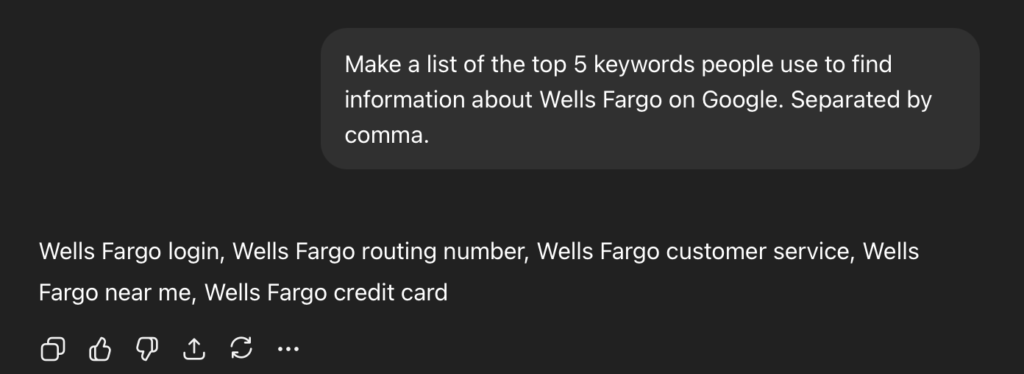
The most common search terms related to Wells Fargo show that customers are primarily looking for account access, routing information, customer support, and credit card details. This indicates that Wells Fargo must prioritize digital accessibility, strong search engine optimization (SEO), and clear website navigation to meet user needs efficiently.
Now that ChatGPT has given us a few keywords for Wells Fargo, we’ll see how you can use AI to create content, such as blog posts, using only prompts
Content Creation
Blog post idea
To create a successful blog post, you have to have some inspiration to start writing your post. So I asked ChatGPT for some help on different ideas for a possible blog. I gave this prompt to ChatGPT: Write 10 blog post ideas about Wells Fargo that the customer persona created earlier is searching for. This was ChatGPT’s response
10 Blog Post Ideas for Wells Fargo (Targeting Maya)
“How to Build a 6-Month Emergency Fund on a $50K Salary.”
Provide practical steps for young professionals to calculate monthly expenses, set realistic savings goals, and automate transfers. Highlight how digital banking tools can help track progress and reduce financial stress while building long-term stability.
“Credit Score 101: How to Improve Your Score in Your 20s.”
Break down how credit scores work, what impacts them most, and simple strategies for improvement. Include tips on responsible credit card use, payment history, and credit monitoring to help young professionals prepare for future milestones like buying a home.
“When Should You Switch Banks? 5 Signs It’s Time to Upgrade”
Explain common reasons young adults outgrow their first bank, such as limited digital tools, high fees, or relocation. Help readers evaluate whether their current bank supports their long-term financial goals.
“Beginner’s Guide to Investing: Where to Start with $100.”
Introduce the basics of investing, including compound growth, risk tolerance, and starting small. Provide simple explanations of stocks, ETFs, and retirement accounts to make investing feel less intimidating for first-time investors.
“Budgeting for Young Professionals: Balancing Rent, Loans, and Savings”
Offer a realistic budgeting framework tailored to early-career professionals managing rent, student loans, and lifestyle expenses. Include strategies like the 50/30/20 rule and automation tools to simplify money management.
“How to Save for a Home While Paying Off Student Loans”
Provide a step-by-step plan for balancing debt repayment with future homeownership goals. Discuss improving credit scores, building a down payment fund, and understanding mortgage readiness.
“Understanding Bank Fees: What to Watch for and How to Avoid Them”
Educate readers on common banking fees such as overdraft charges and monthly maintenance costs. Offer practical tips for avoiding unnecessary fees and choosing accounts that align with their financial habits.
“Digital Banking vs. Credit Unions: Which Is Better for Young Professionals?”
Compare features such as mobile app functionality, accessibility, loan options, and long-term scalability. Help readers determine which banking option best supports their evolving financial needs.
“5 Smart Money Habits to Build Before You Turn 30”
Highlight essential financial habits like automating savings, tracking spending, investing early, and avoiding lifestyle inflation. Position these habits as foundational steps toward long-term financial independence.
“How to Automate Your Savings and Grow Your Money Effortlessly”
Explain how recurring transfers, direct deposit splits, and savings “buckets” can help young professionals build wealth without constant effort. Emphasize how automation reduces stress and encourages consistent saving.
These topics align closely with Maya’s financial goals, budget considerations, and desire for practical, trustworthy banking solutions.
Now that we have a list of ideas we can pick one and ask ChatGPT to write a blog post.
Writing a blog post
I chose the fifth option from the list, because I believe it relates a lot to Maya’s situation with just graduating and starting her career. I also feel that this blog will be able to reach many other young professionals who are interested in learning how to save and budget their income. For the blog post I sent ChatGPT this promt: I want you to act as a blogger with expertise at Wells Fargo. You are writing a blog post for “Budgeting for Young Professionals: Balancing Rent, Loans, and Savings”. This post should be helpful for people learning about budgeting their money and paying off debts. There should be a call to action at the end of each section. The length of the blog post will be 1000 to 2500 words. The tone will be informal. You should write as an individual blogger with a personal approach so do not use plural first-person to refer to yourself. Eg. “our”, or “we”. Only use singular first-person. Do not use passive voice. The response that ChatGPT gave me was:
Budgeting for Young Professionals: Balancing Rent, Loans, and Savings
If I’m being honest, budgeting in your 20s can feel overwhelming. One minute you’re excited about your first real paycheck, and the next you’re wondering where it all went. Rent is expensive, student loans are real, and somehow you’re still expected to save money for the future. I’ve been there, and I know how frustrating it feels to try to balance everything at once. The good news is that you don’t need a perfect system. You just need something realistic that you can actually stick to.
Start With a Clear Picture of Your Money
Before I could improve my finances, I had to understand them. I stopped guessing and started looking at real numbers. I figured out exactly how much I brought home each month after taxes, and then I looked closely at where my money was going. I reviewed my bank transactions and noticed patterns I hadn’t paid attention to before, like how often I was eating out or spending on small things that added up quickly. This step can feel uncomfortable, but it gives you control. When you understand your spending, you can start making intentional decisions instead of reacting.
👉 Call to Action: Take some time today to review your income and expenses. Write everything down so you have a clear starting point.
Use a Simple Budgeting System That Works for You
I used to think budgeting had to be strict to work, but I realized that flexibility actually makes it more effective. One approach that helped me is the 50/30/20 rule, where you divide your income into needs, wants, and savings. However, I quickly learned that not everyone’s situation fits perfectly into those percentages. If your rent is higher or your loans take up more of your income, your budget might look different, and that is completely okay. What matters most is that you have a structure that helps you stay balanced and consistent over time.
👉 Call to Action: Choose a budgeting method that feels manageable for you and adjust it to fit your current lifestyle.
Manage Student Loans Without Feeling Overwhelmed
Student loans can feel like a constant pressure, especially when you are trying to move forward financially. I used to feel like I needed to put all my extra money toward paying them off, but that approach left me feeling drained and discouraged. Instead, I focused on staying consistent. I made sure I paid at least the minimum every month and added extra when I could. Even small additional payments made a difference over time. At the same time, I allowed myself to enjoy my life instead of feeling restricted by my debt.
👉 Call to Action: Look at your student loans today and decide on a realistic amount you can consistently pay each month, even if it is small.
Start Saving Now, Not Later
For a long time, I told myself I would start saving once I made more money. That mindset kept me stuck. I realized that saving is more about habit than income. I started small and set up automatic transfers so I didn’t have to think about it. Even putting away a small amount each week helped me build momentum. Over time, those small contributions added up, and having savings made me feel more secure and less stressed about unexpected expenses.
👉 Call to Action: Set up an automatic transfer to your savings account today, even if it is a small amount.
Find a Balance With Rent
Rent is one of the biggest challenges for young professionals. I’ve definitely felt the impact of watching a large portion of my paycheck go toward housing. While there are general guidelines for how much you should spend on rent, they don’t always reflect real life. If your rent is higher than recommended, it doesn’t mean you are doing something wrong. It just means you may need to adjust other areas of your budget slightly to stay balanced. The goal is to make your rent manageable within your overall financial plan.
👉 Call to Action: Take a look at your rent compared to your income and think about one small adjustment you can make to create better balance.
Budget for Real Life, Not Just Bills
One of the biggest mistakes I made early on was only budgeting for my bills. I didn’t leave room for real-life situations like going out with friends, traveling, or unexpected expenses. When those things came up, I felt like I had failed, even though I hadn’t planned for them in the first place. Now, I make sure to include space in my budget for things I enjoy. This helps me stay consistent because I don’t feel restricted or deprived.
👉 Call to Action: Add a small amount in your budget for personal or fun spending so your plan feels realistic.
Use Tools to Make Budgeting Easier
Budgeting doesn’t have to feel complicated. I rely on simple tools to help me stay on track without overthinking everything. Mobile banking apps make it easy to see where my money is going, and features like spending alerts or automatic payments save time and reduce stress. When everything is organized and easy to access, I feel more confident about my finances and don’t have to constantly monitor every detail.
👉 Call to Action: Open your banking app and explore one feature that can help you better track or manage your money.
Focus on Progress, Not Perfection
This is probably the most important lesson I’ve learned. There were months where everything went exactly as planned, and other months where unexpected expenses threw everything off. At first, I felt like I had failed, but I realized that budgeting isn’t about being perfect. It’s about making progress over time. What matters is that you keep going, adjust when needed, and continue improving your habits.
👉 Call to Action: If your budget hasn’t gone perfectly, don’t start over. Make one better financial decision this week and move forward.
Final Thoughts
Balancing rent, loans, and savings isn’t easy, especially when you’re just starting your career. But it is possible. You don’t need to have everything figured out right away. You just need to understand your money, create a plan that works for your life, and stay consistent. Over time, those small actions will lead to real progress, and you’ll start to feel more confident and in control of your finances.
ChatGPT can not only write blogs but it can also make social media posts as you will see below.
Social media post
Since we now have a blog post that was written by ChatGTP, we can give the next promt: Create a LinkedIn post regarding “Budgeting for Young Professionals: Balancing Rent, Loans, and Savings” for this customer persona. This was the LinkedIn post that ChatGPT wrote
Starting your career is exciting… until rent, student loans, and savings goals all hit at the same time.
Budgeting as a young professional isn’t about cutting out everything you enjoy. It’s about creating balance. Rent often takes the biggest portion of income, student loans feel constant, and saving for the future can seem impossible. But small, consistent habits make a real difference.
When I think about budgeting for early-career professionals, I focus on three things:
• Understanding exactly where your money goes each month
• Creating a realistic plan that fits your lifestyle
• Automating savings so it becomes a habit, not a struggle
Financial growth doesn’t happen overnight. It happens through steady, intentional decisions. Even setting aside a small amount each week builds confidence and long-term stability.
Young professionals don’t need perfect budgets. They need practical systems that grow with them as their income and goals evolve.
If you’re navigating rent, loans, and savings at the same time, what has helped you stay consistent?
#FinancialWellness #YoungProfessionals #Budgeting #CareerGrowth #MoneyManagement
This LinkedIn post was written to attract young professionals like Maya and encourage engagement around financial wellness and realistic budgeting strategies. It connects with early-career individuals balancing rent, loans, and savings while positioning the brand as a helpful and supportive financial resource.
Now that ChatGPT has generated us a blog and LinkedIn post we will see if ChatGPT can create an image for us.
Image Creation
To create this image we will use the help of Leonardo.AI and ChatGPT together. But, before we switch to Leonardo.AI, we’ll ask ChatGPT to deliver a prompt based on all the information already given so that we can enter it into Leonardo.AI to produce an accurate image.The promt I gave ChatGPT was: I am going to draw a picture regarding the text below using an AI image generator. Write a proper prompt – Wells Fargo is committed to delivering exceptional value to its customers and consistently goes above and beyond to support the communities it serves. This was ChatGPTs response:
Here’s a strong, detailed AI image generator prompt you can use:
AI Image Prompt:
Create a professional, realistic illustration of a diverse Wells Fargo team member helping a customer inside a modern bank branch. The scene should convey trust, support, and community engagement. Include warm lighting, friendly facial expressions, and a welcoming atmosphere. Show subtle branding elements such as red and gold color accents associated with Wells Fargo. In the background, include visual cues of community involvement, such as a bulletin board highlighting local events or financial education workshops. The overall tone should feel optimistic, supportive, and community-focused, emphasizing exceptional customer service and long-term relationships. The style should be clean, high-resolution, and suitable for a professional marketing campaign.
After entering the prompt above into Leonardo.AI, multiple AI-generated images were produced. I chose the image that I felt most effectively aligned with the intended concept.

Last Remarks
This project allowed us to see firsthand how impactful AI can be in digital marketing. From building a customer persona and researching keywords to writing a blog, creating a LinkedIn post, and generating an AI image for Scheels, AI tools like ChatGPT made the process efficient and easy to navigate.
Leave a Reply